
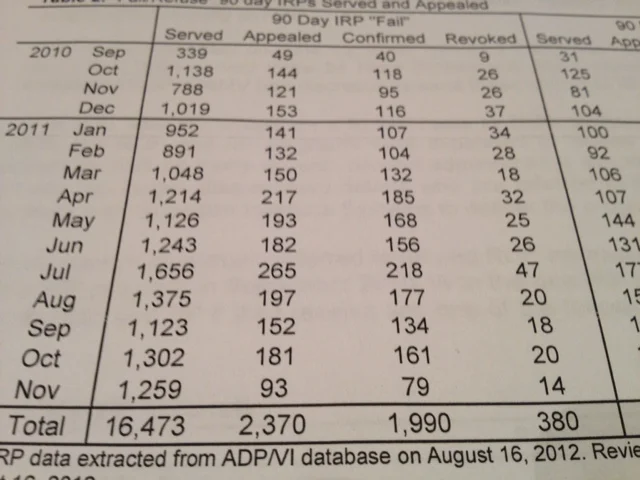
We were curious about the 90-day IRP win rate so we made a request for the statistics pursuant to the Freedom of Information and Protection of Privacy Act. Months later, well after the information could be used by the Court, they sent us the stats. The fact that they held onto it so the Court wouldn’t have a chance to look at it is disturbing. What is also disturbing is what the numbers reveal as we go through them.
As most readers of our blog know, 90-day Immediate Roadside Prohibitions, also known as IRPs or Automatic Roadside Prohibitions or ARPs, are issued by the police in British Columbia if you blow a Fail on an Approved Screening Device or if the officer says you refused to blow. Review hearings take place before adjudicators at the Office of the Superintendent of Motor Vehicles, AKA the OSMV. This is their in-house tribunal. If you get an IRP this is where your fate is decided.
If things are all on the up and up, then you would expect some significant consistency in the numbers over time.
The Fail IRP scheme was in effect from September 2010 to the end of November 2011 when the Court found it unlawful. It’s back now with modifications to give it the veneer of fairness. But really it’s the same thing.
During this time period (September 2010 to November 2011) 16,473 people in BC suffered the indignity of receiving an IRP for Fail. These are the IRPs that were found unlawful / illegal. Of the 16,473 people who received the illegal IRPs, 2370, i.e. only 14% disputed them before the OSMV tribunal.
Even the Government was surprised by the small percentage of people who disputed their illegal IRPs. We heard that the staff at the OSMV were spending their days looking out the windows waiting for people to dispute their illegal IRPs.
What was the 90-day IRP win rate? In other words, what is the percentage of people who were successful in having their illegal IRP revoked on review before the OSMV?
The overall win rate for the illegal IRPs that were reviewed before the OSMV is 16%. But more interesting is the rate from month to month. For example in November 2010, December 2010, January 2011 and February 2011 the percentage revoked was 21% ,24%, 24%, and 21%. But then in March the success rate drops off a cliff. March to June 2011 the revocation rate was 12%, 14%, 12%, 14%. In August 2011 the overall success rate was a mere 10%.
How does it drop off a cliff like that? What is the explanation when the success rate suddenly drops from an average of 21.5% to an average of 13% over comparable back to back periods?
New instructions on how to decide cases? The police suddenly and without explanation beginning in the start of March make nearly 50% fewer mistakes? Suddenly fewer innocent people are on the roads?
Whatever the case, it’s not inexplicable. There is a reason. Our suspicion is that too many people were succeeding on review for someone’s liking. A 22.5% success rate must have cost the Government plenty, having to pay for all of the towing and storage. Also, when around 40 people a month are wrongly punished (of the people who sought a review) it starts to embarrass the Government. Remember that many of those people lost their jobs long before their IRP was revoked.
The saddest part is the number of people who never applied for review. For the illegal Fail IRPs, 14,103 people did not apply for a review of the prohibition. If the 90-day IRP win rate was constant, over 2200 people in British Columbia could have had their illegal IRPs lifted if only they had applied for a review.
On another note, we’ve turned up some very startling and disturbing evidence recently which we will reveal in the next two weeks. When all of the pieces fall into place, we will begin to let our readers know what we’ve found. If you’re following the blog, reviewing our site including the testimonials you might get a hint of what we’ve found.