
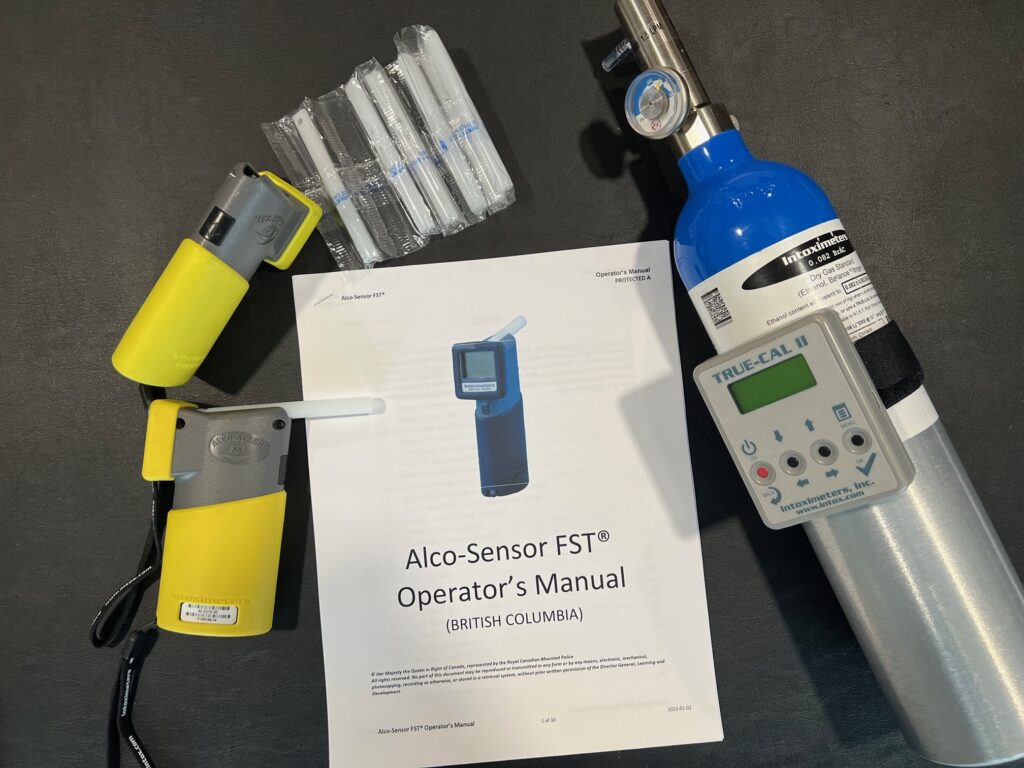
The Superintendent of Motor Vehicles has published a new breathalyzer manual for the Alco-Sensor FST Approved Screening Device, i.e., the roadside breath tester used in British Columbia. This is the 5th version of the manual since this model of ASD was brought into service in January 2015.
The lack of certain changes will come as a disappointment to anyone who was hoping it would be designed to address obvious problems with the Immediate Roadside Prohibition legal scheme.
The changes that were made fail to deal with significant problems and seem to try to undermine logical arguments we have been making that call into question certain points we make in our hearings.
Some background
The IRP scheme came into effect in September 2010 using a different Approved Screening Device. No manual was published. We had these breathalyzers, and we knew there were problems. We started sending in copies of manuals and making arguments to show in some cases the ASDs were unreliable. It caused a crisis for the government. They started creating their own evidence to dispute the evidence we were submitting.
Kyla took one of the cases to BC Supreme Court and in a major ruling the court concluded that the government did not have the authority to create their own evidence. In response, the government changed the law to allow themselves to create their own evidence.
In the summer of 2014, we went public with evidence we collected that showed there was a defect in up to 2500 ASDs that were purchased in the summer of 2010. This was a huge concern. Public and even police confidence in the old ASD was badly undermined and ultimately a decision was made to replace all of the ASD with the Alco-Sensor FST.
Of course, we had a few Alco-Sensor FSTs long before the police had them so we knew there were potential problems. The government knew we in our office had collected a lot of information about them. So with their new power to create their own evidence and to try and get a step ahead of us, they published the Alco-Sensor FST Operator’s Manual (British Columbia) on their website.
The government published the 5th version of this manual on January 2, 2023.
Interestingly, we obtained internal government emails about changes to the manual a couple of years ago. The writers were concerned that if they changed the manual too much it would provide defences to people who had received IRPs. This, of course, should not be a consideration. Although much of the manual is factual, it contains some false statements and a few gross oversights that we had been pointing out for years. Unfortunately, leaving in inaccuracies undermines confidence in the government.
Is change good?
The new version of the Alco-Sensor FST manual for BC retains most of the content of previous manuals. We know from the internal government emails that one goal they have is not to change it too much otherwise Kyla Lee will argue that it’s generally unreliable because they can’t make up their minds. This has not been one of our concerns. We do have legitimate concerns, however.
For example, the manual doesn’t even contemplate circumstances where a person cannot provide a sample due to a disability. In this sense the manual is designed to facilitate discrimination because of a disability. It is a point we have argued for years and yet one more iteration demonstrates that this is systemic discrimination. Many people make a full, legitimate attempt to provide a sample but the ASD fails to test their breath because they cannot meet the flow requirements of the device. That the manual fails to cover this is inexcusable.
The manual addresses the risk of cigarette smoke but it claims the reason for a 5-minute delay from smoking is due to smoke potentially damaging the device. Turns out this is not a risk however smoke may lead to a positive reading for alcohol. They know this. The RCMP did their own internal study which they refused to publish and in fact discontinued when they realized what was happening.
The RCMP forensic toxicology lab knows full well that cigarette smoke can lead to a false FAIL or false WARN on an ASD, yet the manual omits this risk and lies about the cigarette smoke concern.
One glaring omission in the manuals over the years concerns testing people who vape. Vaping has been common for a decade. Testing people when they are vaping is simply unreliable. In some circumstances a 15-minute deprivation period is likely warranted from the time of last vaping and in some cases 5 minutes will suffice.
Changes to the 2023 manual
We did a side-by-side comparison of the new manual with the 2020 publication and here are the few very minor changes.
On page 11 they omitted the paragraph:
ASD demands must be made “immediately” and without delay. The officer must read the ASD demand verbatim as soon as practicable.
On page 13 they changed the instructions on how long the results are displayed. In the previous manual it says “about 10 seconds.” In the new manual it says “about 15 seconds.” This was also changed on page 24.
Discussion
The display time is irrelevant. It is not likely to have any meaningful effect. The bigger question is why did they delete the paragraph about the immediacy of the demand?
The first sentence of that paragraph is an accurate statement of the law and essential for police officers making an ASD demand. “ASD demands must be made “immediately” and without delay” is an accurate statement of the law. If the demand is not made immediately, section 1 of the Charter will not save or permit the violation of the right to counsel guaranteed by section 10(b) of the Charter. The immediacy requirement also may fulfill the section 10(a) requirement and minimize any section 9 violation.
The police must make the demand immediately and have the subject provide a sample immediately. The only permissible delay is to comply with section 8 of the Charter by taking a suitable sample of breath.
It is unfortunate that they have removed this sentence from the manual. We believe they did so because we regularly argue that Charter rights are violated in this regard. We believe that the government is trying to water down the immediacy requirement because the BC Court of Appeal indicated in Gordon v. British Columbia (Superintendent of Motor Vehicles), 2022 BCCA 260 that the Charter would matter in administrative hearings.
Up until this point the Superintendent of Motor Vehicles took the view that Charter violations were not a concern for them. The court indicated that this approach wasn’t really in accordance with the highest law in the land. The court indicated that if evidence is collected in a manner contrary to Charter values, that evidence may not be considered.
It appears to us that the reason they removed the sentence “ASD demands must be made “immediately” and without delay” is to reflect their intention to claim that “immediately” does not apply to the timing of the demand. They intend to take the position that “immediately” only applies to the time from the demand to the sample being taken.
Why is this bad? Firstly, it’s not the law. Our courts have ruled time and again that the timing is immediate to minimize the Charter violations. Secondly, it indicates that the people involved in adjudication have a hand in the creating of the manual (which they, in fact, publish). This impacts the perception of bias which has been an ongoing concern with this tribunal.
What is their answer to our critique? We suspect that they intend to claim that they removed the paragraph because of the second sentence. It’s clever. Maybe they won’t make it now because we’re already calling it out. You see, the second sentence is an incorrect statement of the law. It says “The officer must read the ASD demand verbatim as soon as practicable.” This is not an accurate statement of the law and it is incorrect instructions to the police. The demand must be read immediately, not as soon as practicable.
It appears to us that they removed the entire paragraph because the first sentence defines a clear Charter violation that they wish to back away from, and the second sentence has been removed because it was so obviously wrong. They can plausibly claim they just removed it all because of the faulty second sentence.
In a follow up blog post we’ll cover the omissions that we speak of above, and why this undermines confidence in the new manual.