
Our post on Monday brought up an issue that reporters regularly put to us, i.e. whether the Alco-Sensor IV is a bad breathalyzer and whether there is some other device that would be better.
We touched briefly on some of the problems with the device. For example, without any sign or reason one of our devices suddenly and completely lost its calibration part way through the evening. What if this was a road block and not an office party? The only reason we figured this out is because we had the much more accurate BAC Datamaster and the Intoxilyzer 5000 there to test ourselves, as well as the calibration equipment to check the ASD.
The Alco-Sensor IV cannot be called a bad breathalyzer. It is a useful tool for screening drivers either temporarily to remove them from the road, say for 24 hours, or to take them back to a police station for tests in a controlled environment with a breathalyzer that runs a control to test itself. But it was never intended to be the basis of punishment, and that’s where our Government has gone horribly wrong. (Not to mention all of the other problems we discuss in the previous 200 or so posts.)
But reporters always ask us if this is simply a bad breathalyzer. Why not get a newer more advanced model?
There are a couple of issues there. Firstly, the newer models all use the same basic technology. Secondly, the new models also will be subject to inaccurate tests due to improper testing procedures because roadside tests are not Proper Breath Tests. Thirdly, the newer ASD breathalyzers may be as bad or worse than the ASDs they replaced.
Take, for example, the replacement for the Alco-Sensor IV. This breathalyzer, the Alco-Sensor V, was advertised as a massive improvement over the one that came before. The main advantage is that it has a memory that can retain thousands of test results. The problem, discovered about a year after its introduction, was that it may also provide wildly inaccurate results.
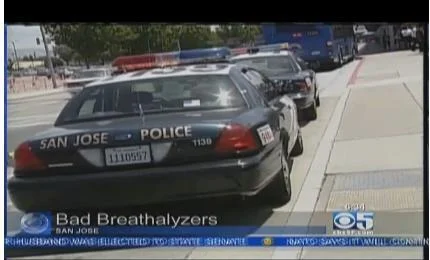
In Palo Alto California, in April of 2010, the police started using the new Alco-Sensor V. In San Jose they started using them the following November. By the summer of 2011, the San Jose Police noticed that a number of their units were giving completely inaccurate readings. Eventually they determined that the new devices were faulty and they were pulled from service. Hundreds of people were expected to have their convictions overturned. You can watch some news video about it here.
Of course, in California, when they determined that the police were using bad breathalyzers, they quickly sought to lift the convictions. Probably they did that because they could count on the courts to give a remedy when these people later sued the police. Litigation can have the positive effect of protecting us all from bad policing, if the courts aren’t shy of granting remedies.
The point, once again, is that testing at the roadside is not reliable, regardless of the device used because the breathalyzers can provide inaccurate readings due to malfunction or contaminating substances.
Sadly, unlike in California, with the IRP scheme in BC we cannot trust the police to inform us when they have identified a bad breathalyzer. In fact, they have done as much as possible to bury the evidence. And at this moment some high-ranking police officers and the Government are actually working in a coordinated scheme to hide the evidence of bad breathalyzers. We will discuss this in the weeks to come.
More links on problems with the Alco-Sensor V:
Faulty Breathalyzers Call South Bay DUI Cases Into Question
Alco Sensor V product recall