
Firstly, we’d like to thank all of the people who have phoned and emailed us in the last couple of weeks. It’s been gratifying to know that so many people support the work we do, and that so many people are following our updates. It’s inspiring to see that people are aware of the threat to the rule of law when we give almost unfettered power to the police or a government agency.
Kitimat ASDs:
Many people (surprisingly) have contacted us about the comment we made a few days back concerning problems with the ASDs in Kitimat. It’s an important issue, but media contacts in Vancouver told us it wasn’t one that would resonate with the Lower Mainland audience. So we decided to put it our there because we felt that it was something that the people in Kitimat deserved to know.
We love Kitimat. Although we’re criminal lawyers based in Vancouver, we’ve had cases all over the place, including Kitimat, and we also assist other lawyers around the province mainly with impaired driving cases. We became suspicious of the ASD maintenance in Kitimat for a number of reasons, so we included it in an FOI to the RCMP in Ottawa.
The information we obtain through FOIs falls into two general categories: that which is clear on the face of it, and that which few would recognize or understand.
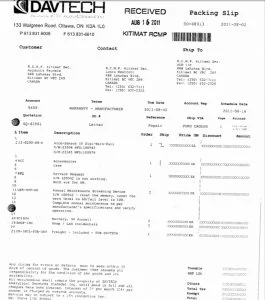
The invoice above is the former of the two. You will see that one of their new units wasn’t working. Of course, we’ll never know how many IRPs were issued using this unit before they recognized that there was a problem. When it was sent for repair, in August 2011, the technician noted that it hadn’t been re-programmed to give a warn at .06mg%, so he did it then.
This was over 8 months after the police in B.C. promised us that every unit had been re-programed to give a warn at 60mg in 100ml. How many people were issued IRPs on the basis of readings from this unit? We’ll never know and the government won’t tell us.
More interesting, from our perspective, and more difficult for most to understand is the calibration procedure that was followed by an officer in Kitimat.
When calibration checks on approved screening devices are performed, there are 6 steps the officer must follow in order to check calibration pursuant to RCMP standards. The last step requires that the officer determine whether the device is operating within the accepted margin of error, or whether it falls outside this range. If the device falls outside the accepted margin of error, the officer performing calibration checks is required to indicate this on the Calibration Check Sheet. He is then supposed to perform calibration steps on the device, before re-checking it.
The Calibration Check Sheet lists the calibration steps necessary to recalibrate the device. There are boxes next to these steps to indicate that each step has been performed. Once re-calibration is done, the officer must perform two more checks to ensure the device is within range. If it is accurate in two subsequent tests, it can be released for use.
In Kitimat, one officer performing calibration is not doing so properly. Rather than check off one box to show whether the device is within or outside the acceptable range, the officer is checking both boxes. As a result, there is no way to know whether the readings fall within or outside the accepted margin of error. In other words, he is checking the box that shows it is calibrated while also checking the box that shows it is not calibrated.
In reviewing the evidence, other Calibration Check Sheets filled out by this officer indicate that the devices are within range. These sheets are properly filled out and demonstrate that this officer may know how to check approved screening devices for calibration.
However, in seventeen separate instances spread across eight different devices, the Calibration Check Sheets appear to indicate the devices are not properly calibrated, if at all. Since the officer has completed other Check Sheets showing properly calibrated devices, it appears that these seventeen checks showed devices were out of calibration.
There is no indication that re-calibration procedures were followed.
The improperly calibrated devices were in circulation between December, 2010 and August, 2011, which is the last month for which we received disclosure. Some of the devices appear to require re-calibration each time they are checked by a different officer. One would naturally suspect that the officer who is checking the wrong boxes wasn’t actually testing the devices at all.
But we’ll never know, and the BC Government isn’t about to help us get at the truth.
Government Bad Faith:
If you read our update from Wednesday, December 14, you’ll know that the Government has instructed adjudicators to not issue decisions on IRP reviews but to simply adjourn the cases without end because the legislation allows them to do this. They can adjourn the decision until after the person has served the entire 90-day prohibition. This allows them to avoid judicial scrutiny, and to get through the back door what they can’t through the front, i.e. prohibit people via unlawful legislation. Other lawyers have contacted us in the last days to confirm that the OSMV is doing this to their clients as well.
It stinks. And we’re shocked that anyone in the Government would go along with it. It’s the type of thing ordered from above by an executive branch that doesn’t know what it’s doing and that believes it has despotic powers.
In any event, we have courts. Sivia is expected to be back in Court on Monday, at which time the Government seems to think this will all blow over and the reprehensible treatment of British Columbians will be forgotten.
We don’t think it’s that easy. We doubt matters dealt with Monday will make it easier to treat people this way, and we suspect that the Government will remain on the defensive.
The Government’s position is illogical and unethical. If it continues past Monday afternoon, we will apply to Court for an order of mandamus at the soonest available date to force the Government to come and explain their position and compel them to re-instate out client’s BCDLs.