
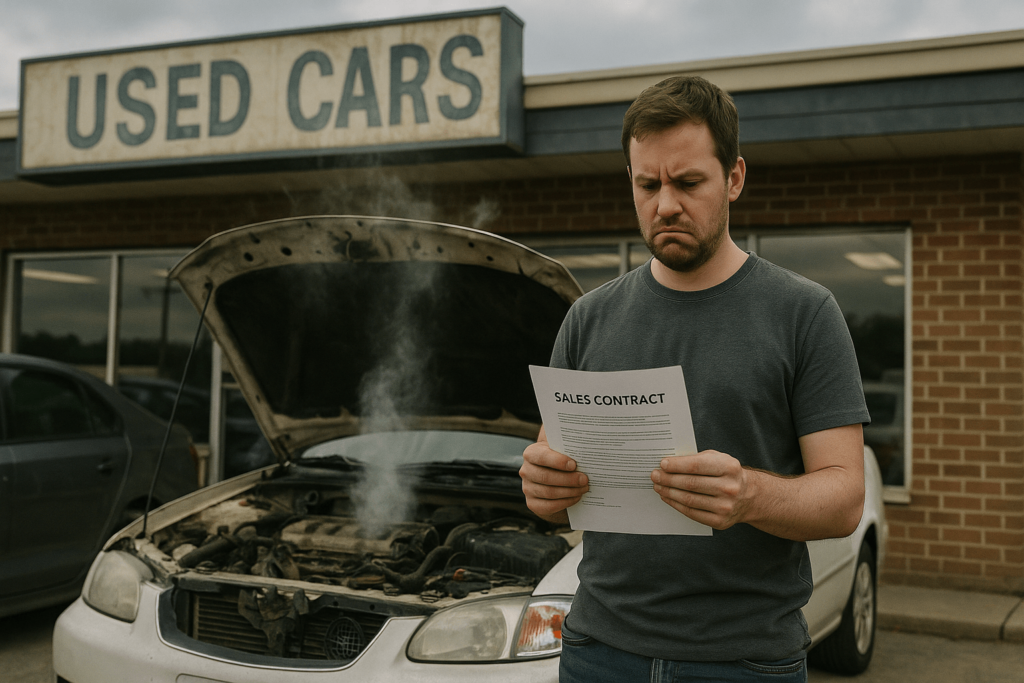
We get folks calling every week dissatisfied about their used car purchase. It usually goes something like this:
“The seller told me the car was running great”
“The dealership didn’t tell me about [some issue] with the car”
“The seller said the car had a clean title”
It is always some version or variation of the above – the newly purchased car has some issues that the buyer did not know about.
Almost invariably, the buyer-caller tells us that they did not bring the car in for an inspection, test drive the car, run records checks, and the like. The buyer relied on the say-so of the seller.
In these situations, our message to the buyer is always the same: the law is not on your side.
The law in B.C.
The law’s starting point is “buyer beware”. Buyers aren’t entitled to repairs, a replacement, or a refund just because they learn of issues shortly after the sale. In other words, the buyer must exercise due diligence in the purchase. The seller has no obligation to tell the buyer about any issues with the car nor do they have the duty to conduct lien searches, accident history searches, repair history searches, origin searches, etc. for you.
The only way to overcome the “buyer beware” rule is if you can show there was fraud, negligent misrepresentation, breach of contract, breach of warranty, or there was a known latent defect.
Misrepresentation
A misrepresentation is a false statement of fact made during negotiations or in an advertisement that induces someone to enter into a contract. If a seller fraudulently or negligently misrepresented a vehicle’s condition, the buyer may be entitled to compensation for losses. It may even terminate the sale.
Both fraudulent and negligent misrepresentations have high legal bars to meet, although comparatively, negligent misrepresentation has a lower burden of proof.
Keeping it simple, for fraudulent misrepresentation, the seller must have known that they were lying to you. So, the seller’s ignorance as to the condition of the car will not be likely enough to establish this type of misrepresentation.
For negligent misrepresentations, so long as another seller would have made a similar claim about the car based on the objective information available at the time, it will also not be likely sufficient to establish this type of misrepresentation. Moreover, for the statement to be negligent it must be objectively untrue, inaccurate, or misleading. For instance, if the seller relied on their maintenance history or, more commonly, a dealership relied on their cursory 12 or 24-point inspection, they would not be likely negligent. Similarly, in a private sale (like on Craigslist, Kijiji, or Facebook Marketplace), if the seller’s honest subjective belief was that “The car was running great” or “There are no problems with the car”, it will probably fall short of proving negligent misrepresentation. Simply put, you would need to prove that nobody else would have made those statements given the objective information/evidence at the time. The court will likely not find negligent misrepresentation if the objective evidence at the time reasonably supports the seller’s subjective belief about the car’s condition.
Latent defect
A reasonable inspection cannot discover a latent defect, unlike a patent or obvious defect. A seller who is aware of a latent defect and fails to disclose or conceal it may be liable for damages. Again, this is a high bar to meet as it would require proof that the seller knew about the defect and did not disclose it. Depending on what the latent defect is, it may or may not entitle the buyer to return the car or void the sale.
Implied warranty
Section 18 of the Sale of Goods Act (SGA) sets out three warranties implied in contracts for the sale of goods, including used goods. Only section 18(c) applies to private sales. That section says that there is an implied warranty that goods sold will be durable for a reasonable period, considering their normal use.
In determining whether a used vehicle is durable for a reasonable period of time, the court will generally consider the vehicle’s age, mileage, price, use of the vehicle, the reason for the breakdown, and the parties’ expectations as shown by any express warranties. This means there must be a substantially significant defect for this section to apply, such as the car does not fulfill its basic function as a car, as opposed to just the radio not working. I often give people this analogy: You buy a couch to be sat on. If one of the couch’s cushions is lumpy, the couch remains substantially durable and would likely not trigger section 18.
It is even more difficult for older vehicles. The court will generally consider older vehicles reasonably durable if buyers can safely drive them when purchased, even if they break down shortly afterwards. Generally, buyers of used vehicles, particularly older models with substantial mileage, must reasonably expect that defects could arise at any time.
I should further add that if the seller explicitly tells the buyer that the sale is “as is, where is”, in other words, what you see is what you get, section 18(c) is also negated.
Breach of contract
Generally, there are two types of breaches in used car sales – minor ones and material ones.
Minor breaches mean that only one part of the contract was not fulfilled. For example, when we buy a car, we expect it to come with four working wheels otherwise the vehicle cannot be driven. But on delivery, one of the wheels was missing. This is a minor breach and would entitle you to compensation for the replacement of the wheel. And no, this in itself would not entitle you to return the car or void the sale.
The seller commits a material breach when they fail to deliver the essential part of the contract. People buy a car to travel from point A to point B. So, if the car does not drive at the time of delivery, this will void the entire contract/sale. If the car drove for a short time and then it broke down, this will likely not be a material breach.
Breach of warranty
This happens when a seller breaks a promise or guarantee about the quality, condition, or performance of the car. For example, the seller makes the statement that “Everything works”, but it turns out the AC did not work. This will entitle you to compensation for the repair or replacement of the AC. It would not entitle you to return the car or void the sale.
There is (some) hope
Fortunately, there are some extra levels of protection for buyers in dealership sales (but this means these protections do not apply to private sales).
The first is the Business Practices and Consumer Protection Act (BPCPA). The BPCPA protects consumers from unfair or deceptive business practices, which may override the buyer-beware rule in some circumstances. It is beyond the scope of this blog to get into how this statute may apply to used car sales, but it is noteworthy that if the dealership sells you an unsafe car (e.g. airbags do not work), the BPCPA may give you the ability to cancel the sale.
The second is the Vehicle Sales Authority (VSA). This government body regulates dealerships/car salespersons, whether for used or new car sales. Again, it is beyond the scope of this blog to dive into this area of used car sales, but it is noteworthy that the VSA has very broad powers, including voiding a sale, albeit this is rare. More often than not the VSA will just discipline or fine the dealership or salesperson.
The message
Most people I speak to look for a way out of the sale because the car was not what they expected, or it was not their “perfect” car because of the later discovered defects or problems. Simply put, they don’t want the car anymore. Unfortunately, the law sides with the seller, not the buyer. The onus is on the buyer to do their due diligence. If the car is not “perfect”, all you can usually hope for is compensation.
If you meet any of the above-mentioned exceptions to the Buyer-Beware Rule or would like us to help you with a VSA claim, give us a call to see how we can help.