
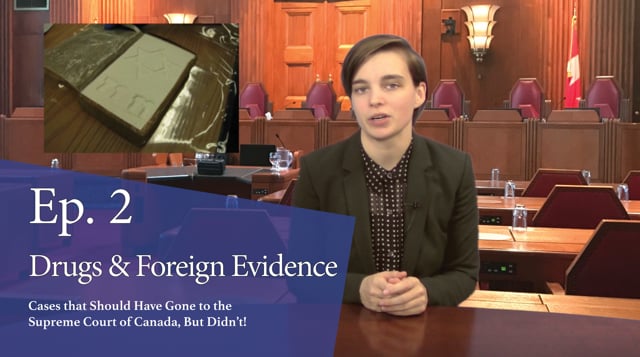
Welcome to Cases That Should Have Gone to the Supreme Court of Canada, But Didn’t! This week, we talk about how the courts should deal with evidence obtained OUTSIDE of Canada, when the prosecution takes place IN Canada.
Acumen Law Corporation lawyer Kyla Lee gives her take on a made-in-Canada court case each week, and discusses why these cases should have been heard by Canada’s highest court: the Supreme Court of Canada.
Drugs and Foreign Evidence
Today, we’re going to talk about the case of Jeremy Stark. Mr Stark and his associate Mr. Mehan were convicted at trial of trafficking cocaine into the border in Canada. A very interesting investigation was done by the RCMP’s Combined Forces Special Enforcement Unit.
The United States’ Drug Enforcement Agency had obtained a warrant to intercept Mr. Stark and Mr. Mehan’s email communications, this was despite the fact that the email communications were on servers in Canada and were being made in Canada.
They got the results of that email interception and forwarded it to the RCMP to allow the opportunity to intercept Mr. Stark and Mr. Mehan.
The big issue was whether it was appropriate for the USA to obtain a warrant to get communications in Canada, then turn them over to the RCMP. The standard DEA officers must comply with is MUCH different from the standards the RCMP use.
So, should the evidence obtained by the DEA have been accepted in Canadian courts?