Lots of people who are stopped for DUI assume that they were over the limit because the machine said so. It’s a funny thing, but it’s difficult for people to wrap their head around the idea that breathalyzers don’t measure their blood. They measure the alcohol in your breath and extrapolate to estimate the alcohol in your blood. There is a margin of error for these devices, and often enough the readings fall outside the margin of error. They can appear to be functioning, and yet the readings can be wrong every time. There may be unknown problems in a particular breathalyzer, or known breathalyzer defects that are kept from public view.
When it comes to the Alco-Sensor IV Approved Screening Devices that the police use in BC for roadside prohibitions, we make disclosure requests to police forces around the province for their records for the devices. It’s handy for us because sometimes the records help us succeed in an Immediate Roadside Prohibition appeal hearing for one of our clients
It’s also a good thing for the drivers of British Columbia. Our disclosure requests have put the police on notice that they must follow correct procedure. If they don’t, we’ll go public with what we find which can be humiliating. The downside is that we have reason to suspect that records are being hidden, notations of problems with devices aren’t written down and breathalyzer defects are going unrecorded. Actually, we’re beyond suspicion. We think in some cases we could prove this without difficulty. We suspect that the reason they’re hiding records is to keep us from exposing problems.
Breathalyzer defects
Still, we have thousands of documents in our office showing major malfunctions in breathalyzers from around BC. One of the known defects that we first exposed concerned the devices displaying temperatures completely at odds with what you would expect.
When looking at an IRP Report to Superintendent, which is the primary disclosure document that we obtain right away, you can see the temperature recorded for the Approved Screening Devices used by the police. If you blow twice, there should be two temperature readings recorded. Of course, you have no idea if the officer actually recorded the true temperature. It’s just as easy to lie about it. There is no internal or external record confirming the temperature. We rely on the cops to be perfect when it comes to IRPs. But something will be recorded and there is the distinct possibility that it’s accurate.
The temperature is important for a couple of reasons. Firstly, if it’s unusually high or unusually low, i.e. outside of a few degrees from the ambient air temperature where the device was stored, then there is a very good chance that the device is malfunctioning. This is one of the breathalyzer defects that we see very often.
RCMP and municipal police records will often disclose that a particular breathalyzer did not display the temperature expected when it came time to test the device during the once-a-month tests. It may have been malfunctioning for the entire month, or perhaps off and on for months.
This is one of the known breathalyzer defects that we identified through our disclosure requests. Sadly, the Government doesn’t notify the people who blew into a defective device that the breathalyzer was later found to be defective. It’s a secret that they don’t want you to know about.
The fact that they don’t notify people that the breathalyzer was defective, indicates to us that the Government doesn’t really care whether the system is fair. They don’t care if innocent people get IRPs.
It’s a revolting state of affairs.
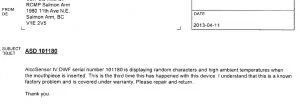
Here’s a portion of a letter speaking of one of the defective breathalyzers. The officer accurately refers to this as a known factory problem. In this case the breathalyzer was returned for service three times for the same problem. Did the Government notify the people who blew into this device about these breathalyzer defects? Of course not. It’s a secret that the Government doesn’t want you to know because it would embarrass them and reveal the absurd and farcical essence of the IRP scheme and the IRP review procedure.