
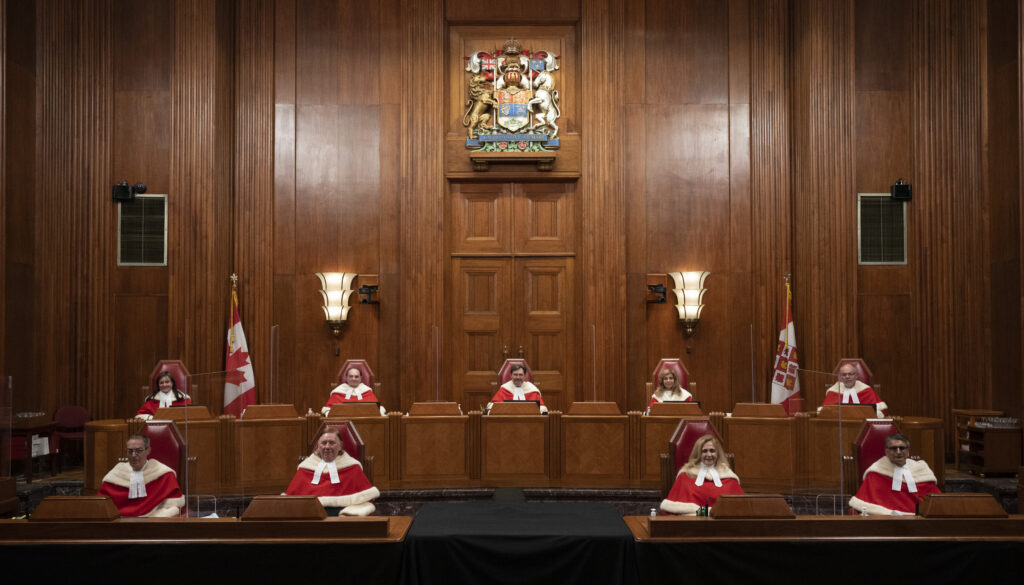
The Supreme Court of Canada has ruled 8-0 that sentencing judges imposing a mandatory minimum driving prohibition under the Criminal Code have the common law discretion to credit the offender with the time the offender was prohibited from driving while awaiting trial.
Justice Nicholas Kasirer’s unanimous judgment clarifies two main points for the bar and bench: (1) that sentences start when imposed and cannot be “backdated;” and (2) that although a sentencing court is required to impose on a first offender at least the one‑year driving prohibition specified as a mandatory minimum penalty (MMP) by Criminal Code s. 259(1)(a), the Code does not bar the sentencing judge from then exercising their common law discretion to credit the offender for the time they were prohibited from driving before sentencing: R. v. Basque 2023 SCC 18.
In other words, time served on a driving prohibition pursuant to the offender’s interim release can be deducted from a mandatory minimum driving prohibition on sentence that would leave the remaining time to be served on sentence below the mandatory minimum.
…
Echoing McKee’s remark that he is “extremely pleased” with the Supreme Court’s ruling, Kyla Lee of Vancouver’s Acumen Law, an expert on drinking and driving law in Canada, commented “I’m very happy with this.”
“I think that this is a positive development for a lot of people,” Lee told Law360 Canada, noting that the desire to avoid a potential driving prohibition is “often a driving factor in people not entering early guilty pleas or pleading guilty for impaired driving offences … so this may prevent unnecessary trials.”
“I think it’s great for the justice system,” Lee added. “I think it will allow things to be more efficient. … On the other hand, there are still concerns that I have as it relates to provincial [automatic driving] suspensions that are triggered on conviction, rather than the passing of sentence, “which means that [Basque] may not actually have the desired effect when it comes to provincial driving prohibitions. But it does potentially open up the ability of people to challenge the constitutionality of provincial driving prohibitions as cruel and unusual punishment, or under other Charter provisions,” she suggested.