
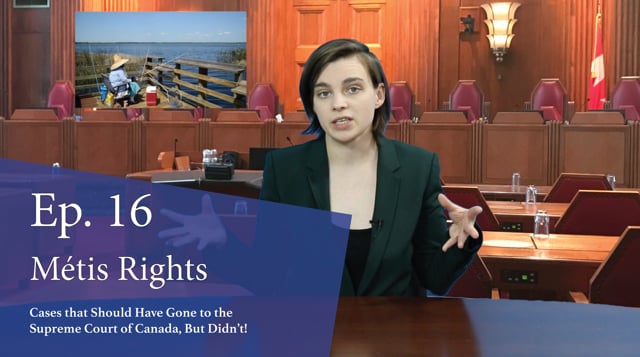
Welcome to Cases That Should Have Gone to the Supreme Court of Canada, But Didn’t! This week, lawyer Kyla Lee discusses who has access to Métis rights in Canada, particularly due to the restrictions of those rights compared to others who identify as aboriginal.
Acumen Law Corporation lawyer Kyla Lee gives her take on a made-in-Canada court case each week, and discusses why these cases should have been heard by Canada’s highest court: the Supreme Court of Canada.
The question of who is “Métis” in Canada is still an undefined issue in law despite this unique culture’s lengthy heritage in the country. In Canada’s law, a person is aboriginal regardless of where they come from in the country as long as their heritage is true.
Not so for the Métis. The rights given to a Métis person is site specific, or specific to an established geographical area in some way. To obtain these rights, a Métis person also has to prove they have a historical Métis community in that specific place.
This is a problem. To understand why, we have to go back through the history of Métis people in Canada. Following the Red River rebellion, Métis people moved out of that traditional Red River basin area and established themselves all around Canada. It’s those people that fit the so-called traditional definition of Métis.
But many people also consider themselves Métis if they have mixed aboriginal and non-aboriginal heritage. So are those people Métis? Do they have the rights associated with being a Métis individual? If so, where are those rights restricted to? To what geographical area?
See more
vancouvercriminallaw.com/category/video/
Follow Kyla on Twitter
twitter.com/irplawyer
Read more about Kyla
vancouvercriminallaw.com/criminal-lawyers-vancouver-richmond-surrey-victoria/kyla-lee/