
The topic of residual mouth alcohol is a common one in any discussion about drinking driving laws. In this context, when someone refers to mouth alcohol, they are typically referencing the presence of alcohol in the mouth when someone is asked to provide a breath sample.
Why is this important? A breathalyzer’s role is to assess the amount of breath alcohol present in a person’s lungs, and to use that analysis to determine what the person’s blood alcohol content would be had the person’s blood been tested. Since the test is essentially detecting alcohol vapours, a single drop of residual mouth alcohol ruins breathalyzer results by producing falsely high readings.
When would a driver ever have residual mouth alcohol?
So let’s bring this to a real-world example. Imagine you had just left the bar after sharing a sampler beer flight with a group of friends. A few ounces of beer for the average adult shouldn’t even approach a WARN level, but lo and behold – there’s a roadblock immediately around the corner. You’re asked to provide a breath sample and to your surprise, it registers a really high number.
What now? Chances are you were not impaired in the slightest, but that residual mouth alcohol from the sampler you just had spiked the results.
In another example, let’s say you had recently finished a drink and were below the warn limit, but burped immediately before blowing into a breathalyzer. That burp would likely have expelled undigested alcohol from your stomach into your mouth, becoming another source of residual mouth alcohol that could tamper with results.
And of course, the mouthwash. You hop in the car seconds after gurgling mouthwash (many of them contain alcohol) and are pulled over and asked to provide a breath sample. You’re completely sober, but you’d better hope whatever traces of alcohol in your mouth are gone when you provide that breath sample.
What about soy sauce? If you’re a sushi lover (and who isn’t) you may be surprised to learn that some soy sauce contains alcohol. Dip your BC roll in soy sauce, jump in the car and you may still have residual mouth alcohol.
Most officers are trained to wait 15 minutes to clear residual mouth alcohol
The law tries to address these flaws, to a degree. Most police manuals require that an officer, if he or she believes a driver has very recently consumed alcohol, to wait 15 minutes before requiring the driver to provide a breath sample. Presumably, that would be enough time to allow any residual mouth alcohol to dissipate.
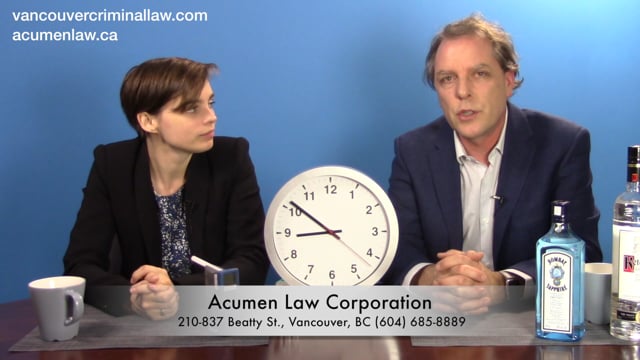
We did a quick office experiment, and found 15 minutes was definitely not enough to eliminate all traces of residual mouth alcohol. In fact, we shouldn’t even have to prove it. Multiple medical studies have suggested that mouth alcohol sticks around for much longer than 15 minutes.
As far back as 1973, researchers had already determined that significant amounts of alcohol could remain in the mouth for as long as 19 minutes. In a more recent study, published in 2013, 47% of one test group had detectable amounts of residual mouth alcohol after 16 minutes. Even older police training materials had suggested waiting for 20 minutes.
Don’t believe us? See our video for yourselves.