
It’s beginning to look a lot like Christmas. A time for family, turkey and DUIs. The festive period is often seen as the worst time of the year for drunk drivers. It’s certainly one of the busiest periods for law enforcement.
It may come as a surprise, then, that the percentage of drivers killed in crashes during the holiday season dropped over the past few years. According to the Traffic Injury Research Foundation (TIRF), nearly 28 percent of drivers killed in crashes in Christmas 2014 had alcohol in their blood compared to 38 percent 10 years before.
That’s also lower than the 31.5 percent of fatally injured drivers who tested positive for alcohol in 2014, the most recent year with available data.
Now there are a number of reasons for this. One is that increased police actually enforcement works. Police being out in numbers is a huge deterrent to people going out for the party season. As a result, many of them use alternatives, such as taxis or a designated driver.
That being said, police will still be out in force. This means your chances of being pulled over are higher. This year, in particular, there are some important things to remember when you hit the road.
Random breath testing
One of the most important changes to impaired driving enforcement to be aware of is the – relatively – new random breath testing rule. This was introduced a year ago but many drivers simply don’t know about it.
To recap, in the past, police officers needed to have a reasonable suspicion that a driver was impaired by alcohol before making a breath test demand at the roadside. That reasonable suspicion standard is gone. It means police may stop you and demand you blow into an approved screening device (ASD).
Whatever you do, do not refuse an ASD demand. The punishment for refusal is the same as blowing a fail. The difference is there are defences available to you if you fail a breath test but relatively few if you refuse.
ADP notice period
Another big change that slipped under a lot of people’s radars is the change to BC’s administrative driving prohibition scheme. The new rules came into effect in September.
Under the old rules, the 90-day driving prohibition began 21 days after the Notice of ADP was issued. The police seized your driving licence but the ADP notice functioned as a temporary driving licence for those 21 days.
The new rules abolished the 21-day waiting period and the driving prohibition will now start immediately after the notice is issued. So if you get an ADP and think you can wait until after the holidays to try to get your licence back, think again. To get back on the road as soon as possible, it is imperative you file a review with the Superintendent of Motor Vehicles straight away. You only have seven days after receiving a Notice of ADP to do so.
If you are visiting BC from another province for Christmas, police may issue a temporary seven-day driving licence if you hold an out-of-province driving licence. Below is an infographic summing up these changes.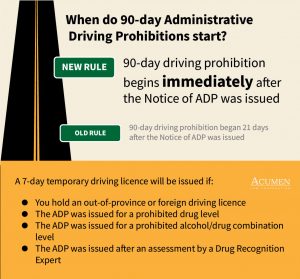
What to do if you get an impaired driving charge this Christmas?
Police will be out there waiting for drunk drivers this Christmas. If you find yourself accused of impaired driving it is important you act fast. Your best bet is to hire a lawyer to mount the strongest possible defence. Acumen Law Corporation deals with more impaired driving cases than any other. We have been there for drivers for more than 20 Christmases and we will be there this year.
Call us for a free consultation on 604-685-8889.