
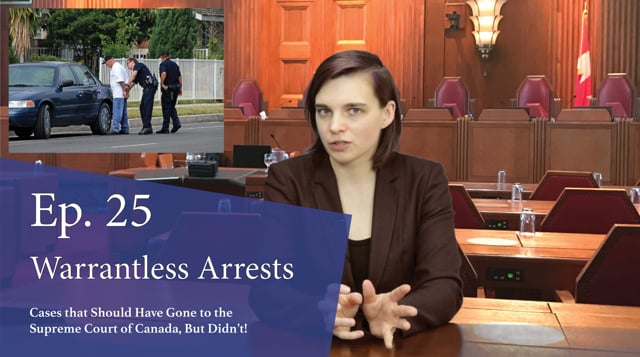
Welcome to Cases That Should Have Gone to the Supreme Court of Canada, But Didn’t! This week, lawyer Kyla Lee discusses the scope of search in warrantless arrests.
Acumen Law Corporation lawyer Kyla Lee gives her take on a made-in-Canada court case each week, and discusses why these cases should have been heard by Canada’s highest court: the Supreme Court of Canada.
In Canada, the law is that if a police officer arrests a person, they are entitled to search that person and the surrounding areas to obtain evidence related to the arrest.
However, in Damion Pearson’s case, he was stopped for impaired driving. The police searched his vehicle in the course of arresting him for the impaired driving offence, and ultimately uncovered evidence that linked Pearson to two murders. He was charged and later convicted of first degree murder on one and second degree murder on the other.
At trial, Mr. Pearson argued that the evidence that was obtained against him as a result of his vehicle search, was obtained in circumstances that violated his rights because the search was not related to impaired driving.
The Supreme Court of Canada had the opportunity to state that if you’re arresting somebody for one thing, you can’t use that as a mechanism to gain evidence for something else you suspect them of doing. There needs to be clearer guidelines regarding how far police can go in the course of arrests for impaired driving versus how far police can go when they are relating their search for the reasons of the arrest.
Watch the video for more.
See more: