
The Charter of Rights and Freedoms is great — if the police kick down your door on a whim without a warrant and then refuse to let you call a lawyer, the plastic bag of cannabis they stumble upon in your cupboard will not be evidence considered by the Court to prove any charge against you. You may feel like a victim of crime, but at least you are not going to jail. This is the upside of the Charter. In egregious cases you have a very good chance of getting a remedy, i.e. an acquittal because the Court refuses to admit the unlawfully obtained evidence. But what if you were not arrested?
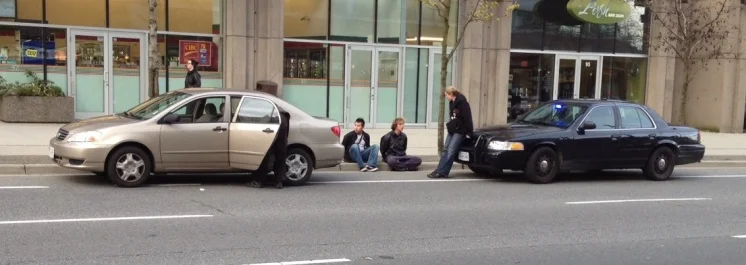
On Monday afternoon we snapped the photo above. Vancouver Police officers had pulled over a Toyota with two young men in it on a major downtown Vancouver street within 100 meters of our office. You can see the humiliating situation. They are handcuffed and forced to sit on the curb (innocent until proven guilty) while another officer searches their vehicle. Do you think that the driver provided informed consent to search his vehicle? Do you think the police had a warrant? Has either of these two fellows had a chance to contact a lawyer? Fat chance.
The police in Canada are permitted to search incidental to arrest. So if these two were lawfully arrested for committing an offence, then perhaps it was a lawful search. But minutes later we saw them driving away. In other words, there appears to have been no arrest and obviously there was no warrant, and it is not likely that either had talked to a lawyer and consented to the search. In other words, this appears to have been an unlawful search.
We hear about this all of the time. About once a week some young man calls us to seek advice about how he was treated by the police. Most of the time they describe an unlawful search where ultimately there was nothing to find and they were eventually released.
The flip side of this is that we seem to get a number of cases with similar facts where there is some crafty justification of the search. Of course, these are the situations in which something contraband is located during the course of the search. And, what do you know? There is always something that lawfulizes it — i.e. makes the search arguably lawful and not a Charter violation.
Of all of the searches that are conducted, how many are actually lawful? How many people have their Charter Rights violated without having a matter go to court?
We know that the police conduct a huge number of unlawful searches. The public does not hear about it because nobody is charged. Only victimized.
From what we see the police have become experts at violating Charter rights and coming up with the right timeline and facts after the discovery of evidence to obfuscate, hide, disguise or justify the Charter violation.
It appears that the two men in the photo were subject to an unlawful (humiliating) detention, subject to an unlawful search where some officer rummaged around in their stuff, and when nothing was found they were sent on their way.
Will they ever get a Charter remedy? Is there any way to stop the police when they are acting in a way that is contrary to law? Can you hold a copy of the Charter out in front of you to stop the police from victimizing you?
No.
You can imagine that their confidence in the justice system is at an all time low. In this respect, the Charter lets us all down.