

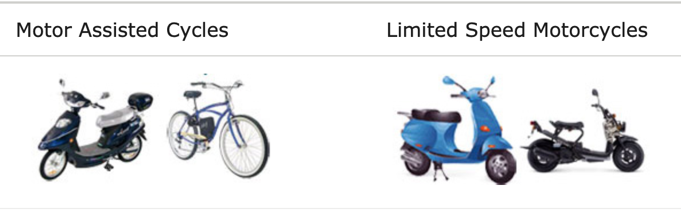
A judge has called for greater clarity in the legal definition of a motor assisted cycle. There are some vehicles you are permitted to drive with a suspended licence, or with no licence at all. While you must have a licence to drive small, limited speed motorcycles, such as 50cc scooters, there are alternatives.
Motor assisted cycles are a different class of vehicle. The Motor Vehicle Act (MVA) permits drivers to operate this type of vehicle, also known as electric bikes or e-bikes, without a licence.
The MVA defines a motor assisted cycle as a device to which pedals or hand cranks are attached that will allow for the cycle to be propelled by human power. Its motor must also not exceed a prescribed power output.
That prescribed output is stipulated in the Motor Assisted Cycle Regulation to be 500 watts. The other regulations include: the motor must be electric, the vehicle must not be capable of travelling faster than 32 km/hr on level ground. The cycle may not have more than two wheels in contact with the ground. The wheels are also must not exceed 350 mm in diameter.
Motor assisted cycles must also have a mechanism that prevents the motor from turning on at speeds below 3 km/hr. The motor must also switch off if the rider stops pedalling, releases the accelerator or applies the brakes.
Confusion over motor assisted cycles
As discussed in a previous blog, there is still a lot of confusion surrounding e-bikes. The issue of what constitutes a motor assisted cycle arose in a recent judgement.
The officer charged Mr. Wojtkiw with driving without insurance and driving without a licence. An officer who clocked him travelling at 48 km/hr pulled him over. Mr. Wojtkiw did not possess a driver’s licence so the question was whether his vehicle required one.
The Crown submitted that a motor assisted cycle must look like a bicycle with an electric motor and anything that does not would “offend the spirit of the legislation”. The judicial justice, however, pointed out the difference between this view and the pictures of a motor assisted cycle on the ICBC website.
Motor assisted cycle pedals
There was also a question of whether the pedals on Mr. Wojtkiw’s vehicle failed to comply with the Motor Assisted Cycle Regulation. The pedals were adjusted such that they were side-by-side rather than one always positioned ahead of the other. The officer who pulled him over argued this was contrary to the Regulation, however, the judicial justice said: “Although unconventional, I conclude the repositioning of the pedals did not remove the cycle from that requirement of the definition.”
The other issue was the evidence that Mr. Wojtkiw’s travelled 16 km/hr above the maximum allowed speed for an e-bike. The judicial justice concluded that at some point, either someone disabled the mechanism for governing the speed or it malfunctioned. This did not, however, remove the vehicle from its classification as an electric bike.
The judicial justice said:
To use an analogy, another prescribed criteria…requires that the braking system on a motor assisted cycle must be capable of bringing the cycle, while being operated at a speed of 30 km/hr, to a full stop within nine metres from the point at which the brakes were applied. If the braking system was out of proper repair and only brought the cycle to a stop at 10 or 11 metres, that surely would not automatically remove that cycle from being a motor assisted cycle
This meant the speed did not preclude the vehicle from being a motor assisted cycle and the defendant was, therefore, innocent of the charges.
Insurance
The fact e-bikes are uninsurable further complicates matters. ICBC does not sell it. To find Mr. Wojtkiw guilty of driving without insurance, then, would create a bizarre catch-22. Or as the judicial justice put it: “If the legislation requires a vehicle to be registered and insured, it surely must permit a person to register and insure that vehicle, which clearly ICBC says cannot be done.”
Need for clarity
Given the contradictions between the Motor Assisted Cycle Regulations and the Crown’s and ICBC’s definition, the judicial justice to call for a revision of the rules. He said: “It is now seven years later and, like cell phones, much has changed with electrically propelled devices. I concur in the need for a review.”
As we have seen, the rules can be quite consuming. Hopefully, there will be an update soon. For now, if you find yourself in trouble with the law over an e-bike, call us on 604-685-8889 for a free consultation.