
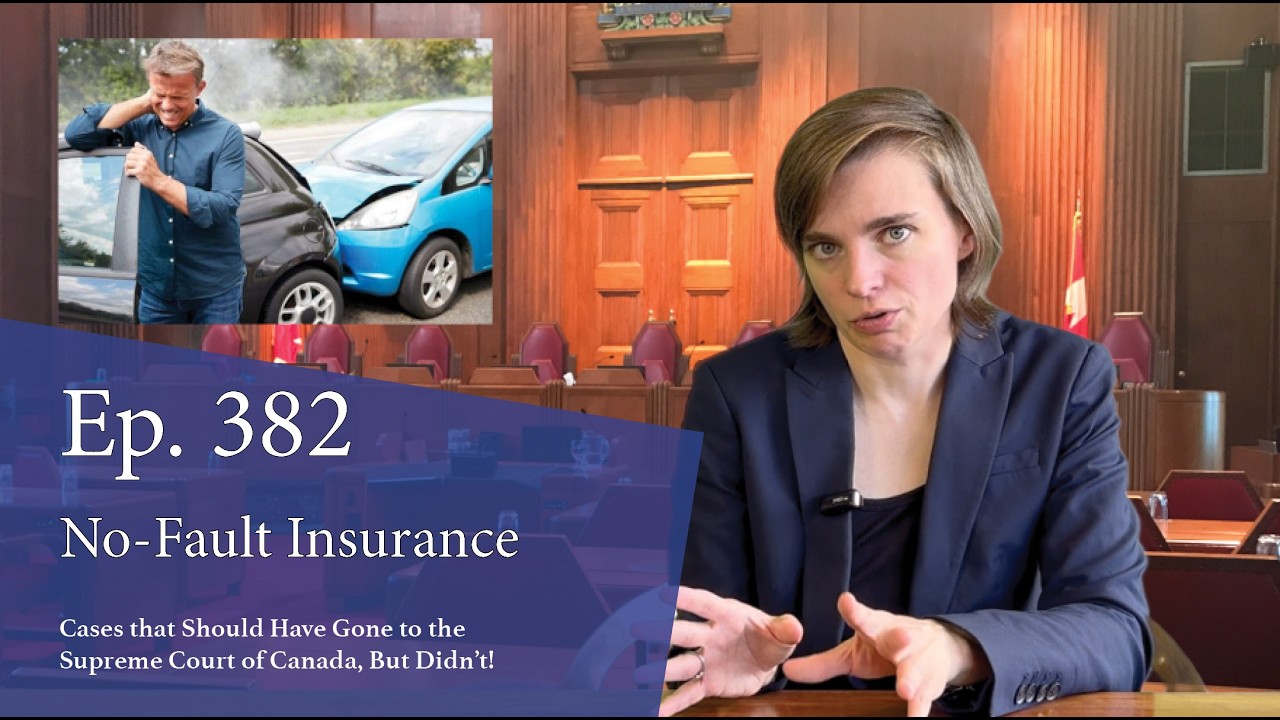
Welcome to “Cases That Should Have Gone to the Supreme Court of Canada, But Didn’t!”
In this episode, Kyla Lee from Acumen Law Corporation examines two cases involving no fault insurance and the question of what it means for an injury to arise from a motor vehicle accident. Under no fault insurance systems, individuals generally cannot sue another driver for injuries sustained in a collision and must instead seek compensation through the applicable insurance scheme. The cases raised difficult questions about where the line should be drawn when an injury is connected to a motor vehicle accident but may also have another cause.
Key Points Discussed
– Two insured individuals sought clarification on what constitutes an injury arising from a motor vehicle accident
– No fault insurance schemes generally replace traditional civil lawsuits with insurer administered compensation
– The cases involved disputes over whether the claimed injuries were sufficiently connected to motor vehicle accidents
– In one case, an individual was shot, later drove a vehicle, lost consciousness, and crashed
– The insurer argued that the injuries resulted from the gunshot rather than the collision
– The cases raised broader questions about causation, compensation, and access to justice under no fault insurance
Why This Case Matters
No fault insurance significantly changes how people seek compensation after motor vehicle accidents. Instead of suing another driver and having a court assess damages, injured individuals are often limited to the compensation available through the insurer and the appeal mechanisms built into the system.
That makes the definition of an injury arising from a motor vehicle accident especially important. If the connection is interpreted too narrowly, individuals may be denied no fault benefits even though a collision contributed to their injuries. At the same time, restrictions on civil lawsuits may prevent them from seeking compensation through the courts.
Missed Opportunity for a National Standard
The Supreme Court of Canada could have clarified:
– What degree of connection is required between an injury and a motor vehicle accident
– How courts and insurers should assess injuries with multiple contributing causes
– Whether injuries sustained during a collision can fall within no fault coverage even when another event contributed to them
– How no fault insurance restrictions should interact with access to civil remedies
Need for Clarity and Accountability
As no fault insurance becomes more common, clear rules around causation and coverage become increasingly important. Individuals should not be left in a situation where an insurer says an injury was not caused by a motor vehicle accident while civil legislation simultaneously prevents them from bringing a lawsuit because the injury is considered connected to one.
Greater guidance could help define the boundaries of no fault insurance and ensure people have a meaningful path to compensation when injuries involve complex factual circumstances.
Topics Covered
– No fault insurance
– Motor vehicle accident compensation
– Causation of injuries
– Access to civil remedies
– Insurance coverage disputes
– Access to justice