
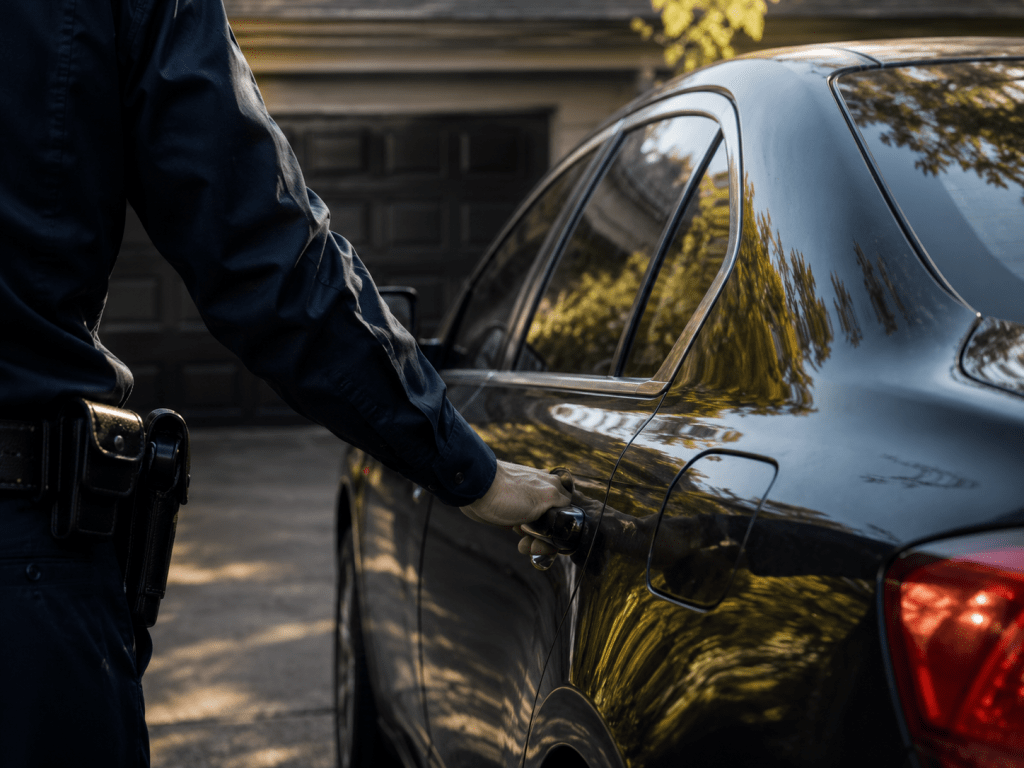
If police showed up at your home, walked up your driveway, and opened your car door to begin an impaired driving investigation, you might have a stronger case than you realize. In February 2026, the Supreme Court of Canada released its decision in R. v. Singer, 2026 SCC 8, and it has changed the rules for how officers can investigate a suspected impaired driver on private property.
For anyone in British Columbia facing an impaired driving charge that started at home, in a driveway, or in a parking lot attached to a residence, this decision is not an abstract legal development. It may be the single most important case on your file.
What happened in R. v. Singer
Around midnight in a small Saskatchewan First Nations community, RCMP officers were investigating a complaint about a suspected drunk driver. After roughly an hour of looking, they located a truck matching the description parked in a residential driveway. The lights were on and the engine was running. From the road, the officers could not see anyone in the truck.
The officers walked onto the driveway and approached the vehicle. Inside, they saw Mr. Singer sleeping or unconscious in the driver’s seat. They knocked on the window for several minutes. When he did not respond, they opened the door. Once the door was open, they smelled alcohol. They woke him, he eventually provided a roadside sample that registered a fail, and he was arrested. At the station, he refused further samples and was charged with refusal.
What the Supreme Court decided
The Court split the officers’ conduct into two separate acts. The first was walking up the driveway. That, the Court held, was fine. Under what lawyers call the implied licence doctrine, members of the public, including police, are generally allowed to approach a home or vehicle on private property for the purpose of communicating with an occupant. This is the same reason a neighbour, a delivery driver, or a person collecting signatures can come to your door without being a trespasser.
The second act was opening the truck door. That, the Court held, crossed the line. Opening a closed vehicle door allowed the officers to intrude into a private space and gather evidence that was otherwise sealed off from them. That is a search under section 8 of the Canadian Charter of Rights and Freedoms. Without a warrant or some other specific legal authority, it was unconstitutional.
Interestingly, the Court declined to exclude the evidence under section 24(2) of the Charter. It concluded that the impact on Mr. Singer’s privacy, while real, was not so serious that admitting the evidence would bring the administration of justice into disrepute. So the conviction stood, but the legal principle going forward is clear.
Why this matters if you are facing an impaired driving charge in British Columbia
A large portion of impaired driving investigations in BC begin somewhere other than a routine roadside stop. Sometimes police are called by a neighbour. Sometimes they follow a vehicle into a driveway or parking lot. Sometimes they find someone asleep in a parked car in a residential area. After Singer, the specific physical steps the officers took on private property matter enormously.
Some of the questions a lawyer may consider are the following: Did officers simply approach and knock, or did they physically enter your vehicle? Did they open a closed door, a trunk, or a glove box before they had lawful authority? Did they have a warrant? Did they have a reasonable basis to believe you were in medical distress, which can sometimes authorize entry on safety grounds? Did the officers tell you why they were there, or did they simply start investigating?
These questions sound technical, and they are. They often turn on two or three seconds of police conduct and whether that conduct was documented accurately in the officer’s notes. Those details do not leap off the page of a disclosure package for someone without training.
How Singer interacts with BC’s administrative penalties
British Columbia has one of the most aggressive administrative impaired driving regimes in Canada. Immediate Roadside Prohibitions, 90-day administrative driving prohibitions, and vehicle impoundments can all flow from the same investigation that leads to a criminal charge. Charter violations that occur during the investigation can provide grounds to challenge the criminal charge and, in the right circumstances, may also factor into review of the administrative penalties.
This is one of the reasons that treating an impaired driving file as two parallel cases, criminal and administrative, is so important. A Singer-type argument that collapses the criminal case does not automatically erase the IRP, but the underlying facts may be usable on review, and the disclosure obtained through the criminal process often provides critical ammunition.
What a lawyer specifically does on a case like this
If the investigation that led to your charges happened on private property, here is what a defence lawyer does that you realistically cannot do yourself.
First, a lawyer orders full disclosure and cross-references it. In BC impaired driving cases, police generate multiple documents for the same incident. There is the Report to Crown Counsel narrative. There is a separate report for the 90-day Administrative Driving Prohibition. There may be a 24-hour prohibition report, a vehicle impoundment report, an IRP Report to the Superintendent, and a contemporaneous synopsis written the same day before the full narrative is prepared. Each of these is written at a different moment by officers who may remember things differently. Inconsistencies between them are often where defences are built.
Second, a lawyer identifies the exact physical acts that occurred on the property and maps them onto the Singer analysis. Standing on the driveway is protected. Opening a door is not. Shining a flashlight through a window may or may not be, depending on the circumstances. Reaching into a vehicle, even to turn off an engine, is a search. A lawyer who does this work every week knows where the lines are.
Third, a lawyer preserves Charter arguments properly. Simply mentioning a Charter breach in court does not preserve it. A proper section 8 argument requires a formal application, a detailed notice, and in most cases a voir dire during which the officer’s conduct is tested under cross-examination. Running this process is not something that can be done on the fly.
Fourth, a lawyer negotiates with the Crown using the leverage the case law provides. Crown prosecutors know Singer. When a lawyer approaches a file with a credible section 8 argument, the Crown’s risk calculation changes. This can translate into withdrawn charges, reduced charges, or a better resolution before the case ever gets to trial.
Frequently asked questions
Does Singer apply to my case if I was stopped on the road, not at home?
The core holding is specifically about private property, so if your stop happened on a public road, Singer does not directly apply. However, the same decision reaffirmed important principles about when searches of vehicles require a warrant, and those principles can still apply to roadside investigations in some circumstances.
What about apartment parking lots, underground parkades, or shared driveways?
The Charter analysis turns on reasonable expectation of privacy, which depends on the specific space. A private driveway at a detached home is clearly private. A designated parking stall in a locked underground parkade has a strong privacy claim. An open visitor stall in an unsecured lot is weaker. These are exactly the kinds of distinctions that matter and that a defence lawyer will argue.
The officer said they were worried I needed medical help. Does that change things?
Police do have some authority to enter private spaces to render aid in a genuine emergency. That said, courts scrutinize medical-aid justifications carefully, especially when the officers proceeded to conduct an impaired driving investigation the moment they got access to the person. If the real purpose was investigation, not aid, the justification may not hold up.
Can I argue Singer on my Immediate Roadside Prohibition review?
IRP reviews are narrower in scope than criminal trials and do not always allow full Charter arguments. However, the factual record developed in the criminal case, including how the officer behaved on private property, can be highly relevant to the IRP review, and strategic coordination between the two matters makes a real difference.
The evidence was admitted in Singer anyway. Does that mean Charter arguments are pointless?
No. The section 24(2) analysis is highly fact-specific. Every case has different facts and different police conduct. Evidence gets excluded in impaired driving cases all the time, and Singer did not change the test. It clarified when a breach occurs. What happens after that breach still depends on the circumstances of your case.
How soon do I need to get a lawyer involved if my arrest happened at home?
As soon as possible. Some evidence, including dashcam video, bodycam video, and 911 audio, is only retained for a limited period. Preservation requests have to go in quickly. The factual record of exactly where officers stood, what they touched, and when each action occurred is also easier to reconstruct while the memory is fresh.