
The Globe and Mail reported Saturday that the Government expects to argue that 90-day Immediate Roadside Prohibitions for refusal allegations should be untouched by the November 30th ruling.
As far as we’re concerned it is the 90-day scheme that was found unconstitutional, with an immediate prohibition, vehicle impoundment, RDP and interlock, fines, etc.; without an actual possibility to investigate the evidence, no decision on a hearing for two to three weeks into the punishment (or much longer), no substantive disclosure, no cross examination, no prosecutor, no Charter arguments, no face to face hearing with a legally-trained adjudicator, no publication of tribunal decisions for public scrutiny, no application of precedent, no opportunity to review the records of the device or the officer, reliance on hearsay without even naming the alleged witness, no requirement to prove a time of driving, no requirement to prove that the officer is qualified to use the device, and on and on.
In some respects the IRP scheme is unnecessary duplication of the ADP scheme when you are alleged to have refused to provide a proper ASD sample. There is still a 90-day prohibition. The main difference is that the police need to provide more evidence with an ADP, and typically they are actually conducting a criminal investigation, so they take extra steps to collect more reliable evidence.
What do we mean by that? For a Criminal Code investigation for alleged ASD refusal, the police typically would have the subject attempt to blow at least 6 times using 2 mouthpieces. The police would record the results of each attempt, typically TEST flashing on the display, NoGo and eventually sometimes VOID. The police would attempt to describe each attempt, and provide a great deal of the circumstances leading up to the attempt. They would make notes about the device and sometimes test it afterward.
With the IRP scheme we noticed that the police very rarely (almost never) used more than one mouthpiece, (cost $0.25) and sometimes they would describe as few as two attempts. Sometimes they wouldn’t even describe an attempt – just their opinion that the person wasn’t trying. Often their description did not jibe with how the devices function.
In one upsetting case, the disclosure indicated that the device was malfunctioning. The temperature clearly recorded by the officer showed it was outside the range in which it would function properly. The client credibly described his attempts to provide a sample. His evidence was rejected because the officer was of the opinion he wasn’t trying (to blow properly into a malfunctioning ASD).
In criminal ASD refusal allegation cases, wrongfully conviction/punishment such as the above were unlikely, rather than commonplace as we have seen with IRPs.
Some examples:
Two years ago we noticed that we had 4 files with the same police officer alleging roadside refusals, all from the same month. These were criminal cases, so we obtained disclosure and ultimately all of the matters were scheduled for trial. What we determined, speaking with our clients was that in each case the officer indicated that they didn’t need to blow – that the result would be the same, so they could just refuse and be free to go in a few minutes. The officer invited them to refuse. We figure that he did this simply because it was easier. None of the cases made it to court, because the prosecutors were smart and saw what was going on.
We were consulted by another lawyer who obtained dash cam video evidence in an ASD criminal refusal case. The Burnaby RCMP officer pulled the subject over on Highway 1 eastbound. There were two officers. The main investigator was verbally abusive to the accused. He demanded that the subject exit his vehicle and stand at the front of the cruiser. The second officer retrieved the ASD. The main investigator read the ASD demand to the subject extremely quickly, and with a number of errors that rendered it worthless. He then attempted to insert the mouthpiece backward. When that didn’t work he asked the second officer “is this thing calibrated?” The second officer didn’t know.
When he got it working he held the device to the subject’s mouth for less than a second before yanking it away. He then berated the subject for 30 seconds. He did this again, lifting it to his mouth for less than a second and pulling it away and berating the accused. The third time he lifted the device, and it appeared to time out before it made it to the fellow’s lips. The officer then said “that’s it – you’re being charged with refusing.”
The prosecutor who approved the charge relied on the police paperwork to conclude an offence was committed. They did not receive the dash-cam video until the trial date approached. They withdrew the charge after watching the video.
One of our former clients, a distinguished man in his late 50s, was at a loss to explain why the device did not accept his attempts to blow. He had some scientific training, and particular knowledge of alcohol chemistry and the effects of alcohol due to his occupation. He never consumed more than one drink per day, as his long-time friends all confirmed. He had no reason to obstruct the sample. He told the police he was trying to blow. He was charged with the Criminal charge of ASD refusal.
In one of our meetings, trying to get to the bottom of it, we had him attempt to provide a sample into one of our AlcoSensor IVs. His neck twitched and it was clear that he was not forming a seal around the mouthpiece. When we asked about his neck, he explained that as a child in Europe after WWII he contracted polio, and as a result one side of his body was significantly underdeveloped. On one side of his body, the muscles in his chest, neck and around his mouth were deficient. It was a physical ailment that kept him from being able to provide a sample into the ASD.
We have witnessed that some people simply cannot provide a sample that fits the parameters of the device. When we have demonstrated the AlcoSensor IV for clients, from time to time we’ve blown NoGos when we were trying to provide a sample. And the disclosure we’ve reviewed indicates that very often the devices are not operating properly, causing false readings.
In each of the criminal cases above, the charges were dropped because the subjects did not refuse. Had these individuals received 90-day IRPs, they would have been stuck with the wrongful punishment because of the flawed review process. The same review process that the Court has found to be a Charter breach.
We expect that, if the Government tries to distinguish fail cases from alleged refusals, the Court may choose not to rule on that issue because it was not part of the case put before it. Or the Court may hold that it is part of the same 90-day scheme and that it would be a ridiculous exercise to start cutting here and there when the scheme itself is the issue.
If the Court goes the other way, i.e. says that 90-day IRPs for refusal are somehow okay, you can expect that there will be a sudden spike in alleged refusal cases. If the Government is permitted to rely on unlawful legislation when the police are supposedly thwarted in their attempt to obtain a sample, you can expect that the police will ensure that nobody every provides a sample.
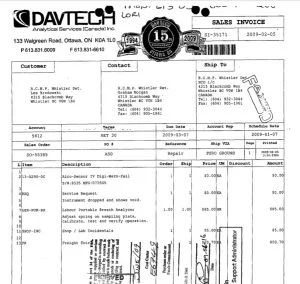
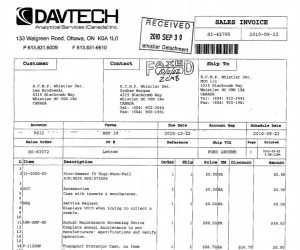
If you’re wondering how an ASD malfunction could cause the police to honestly mistake a legitimate attempt as a refusal, take a look at the FOI material from yesterday’s post, or the documents below from Whistler.
The first is an invoice from February 2009, which says that the device has been dropped and indicates that it now goes to Void. What would have been happening is that when the person went to provide a sample, VOID would appear on the display. One of the readings an officer may legitimately assume is displayed due to a possible refusal is a VOID reading. So the device was sent for repair.
The second invoice is for the same device. The invoice describes the malfunction “Displays VOID when trying to collect a sample.” This invoice is from September 2010, indicating the same problem. Had it ever been properly fixed? Did they repair one component only to overlook another?
One final note: if a subject blows even the tiniest bit of air into the AlcoSensor IV, the officer can press the manual button and obtain a sample. For some unfathomable reason they are trained not to use it. Each time they calibrate one of these devices using a gas canister, they press the manual button to obtain the sample because the canister does not blow hard enough for the device to accept the sample. And they assume that the gas canister reading is accurate.
Bearing this in mind, there is no reason to not use the manual button in 90% of all cases where the person is not blowing hard enough. But they never use it.
The last final note: the 90-day scheme with respect to alleged ASD refusal cases is a clear replacement of the criminal law, ousting the federal legislation, because the offence is identical and it relies on the identical set of facts. So, if the Government wants to argue refusal cases, they will run into a problem that they narrowly avoided in the November 30th decision.