
A hot topic this week has been whether the Government can rely on the unlawful legislative scheme if the police allege that the subject failed or refused to blow. In other words, if they don’t get a sample, can they then say that the search and seizure wasn’t unreasonable because there are no results to consider?
Some people are wondering if the Government is going to ask the Court to allow 90-day Immediate Roadside Prohibitions if the allegation is of failing or refusing to provide a breath sample. We don’t think they’ll be that silly – if you’ve been told that you can’t have pie before dinner, you wouldn’t then conclude it’s okay to serve yourself a slice of cake. The legislative scheme that the police operated under and pursuant to which they served the prohibitions has been found, at its very essence, to violate the Charter.
The s.8 violation includes the results displayed on the ASD that cause the officer to conclude that it is a refusal situation. In other words, there are results to consider. The scheme did not allow you to obtain the information to challenge the results, i.e. the disclosure that indicated the device wasn’t working or that the officer didn’t know how to operate it, or that the officer didn’t actually write the report (don’t laugh – we’ve seen it and the prohib was upheld on review). You could not cross-examine the officer. The harsh consequences still followed. The Notice of Prohibition was still served pursuant to a constitutionally invalid scheme. The inadequacies of the review process are identical. Still, for the purpose of argument, in the next few days we’ll go through some of the other aspects of a refusal situation.
The s.8 violation arises because the scheme does not allow a person to make full answer and defence to the allegation. With IRPs, the punishment begins before the hearing which typically takes place about 14 days into the prohibition. The decision, until recently, was usually rendered one week later. The OSMV would take no steps to assist you to obtain the evidence to deal with the allegation, and recently even took the position that they had no such obligation despite Court rulings to the contrary. If you contacted the police, they’d simply refuse to give you any further disclosure. If you made an FOI, what would you get?
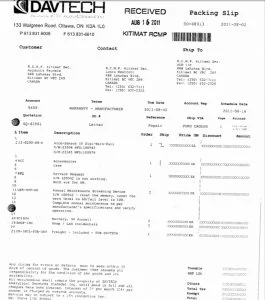
The soonest the police have disclosed documents to us pursuant to an FOI is 60 days later. When they have, it is always incomplete. Some detachments, such as Delta, have refused to give it to us because the officer knew we opposed the IRP scheme. What we have invariably found is that, even with incomplete disclosure there is always evidence that shows devices are malfunctioning leading to false refusal allegations.
For example, if you click on the image above, you’ll get a pdf of a letter describing a problem with an ASD in Kamloops. The letter describes that the officer responsible for the ASDs has noticed that a certain device gives a NoGo reading when tested.
Testing the devices happens once a month. Any officer observing a subject blowing would conclude that the person wasn’t blowing or was trying to provide an inadequate sample. That’s what NoGo is supposed to mean. This device was likely in service for close to 30 days before the problem was noticed. How many people received IRPs due to this device over that period? We don’t know, the OSMV doesn’t care and the RCMP didn’t notify anyone that their device was malfunctioning.
Had our client faced a criminal charge of refusal with this device, we would have obtained the disclosure before the trial because we’re smart criminal lawyers. But with an IRP, the Government was able to hide the disclosure. So, the inadequacies in the fact-finding process were the same as had the subject provided an inaccurate fail sample.
An interesting aside: there is no valve that could be sticky and cause a false NoGo. There are a dozen other possible reasons. The comment that the officer thought it was a sticky valve indicates a general lack of understanding of the potential problems and faults with these units that we see in every detachment.
None of the information that we managed to get through great effort would be available to a person dealing with an IRP for an alleged ASD refusal. The ability to challenge the search is therefor unreasonable. Which brings us back to the same s.8 analysis.
In our experience, as a percentage of the total number of IRPs issued, refusal allegations were the most likely to result in wrongful prohibitions. We would not be surprised if more than 50% of IRPs issued for refusal would have been overturned had a proper review procedure been implemented.
We’ll try to post more about refusal situations in the next few days, time permitting.
If you’re interested in studying why these devices give false readings, take a look at the invoice below.

The service request for unit bearing serial number 72502 describes the problem as “Set button not always working & temp not reading & inaccurate.” What does this mean, aside from the indication that it was functioning intermittently? In this context the word “always” means that the Pemberton RCMP kept using it for a while despite numerous severe problems.
Set: it’s not always properly resetting the sample chamber to position
Temperature: the thermometer is shot, the wiring harness to the thermometer is shot, the motherboard is shot, the eprom is shot, the contacts to the motherboard are corroded…
Inaccurate: OMG