
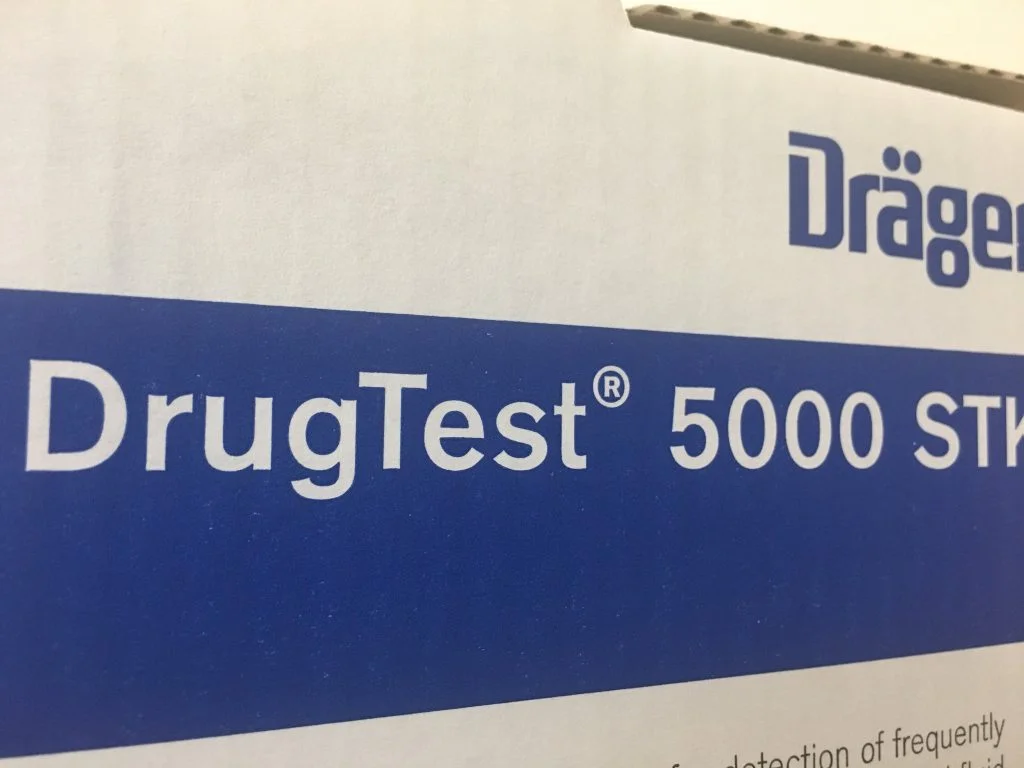
As we’ve said, for a long time now we had an inkling that the federal government would choose the Dräger DrugTest 5000 as the approved drug screening device for Canada. We had some intel on the device, mostly from our American counterparts and from information we could find on the internet. Recently we came into possession of a lot more information that has solidified our view that this device will not be the game changer Canadian police are looking for.
There is a lot that Dräger has managed to keep from becoming widely known. Here are the top five things we didn’t know about the Dräger DrugTest 5000 (plus a few extra) until we got our hands on this new information:
1) Fentanyl is not one of the compounds identified by the device
Opioid abuse and particularly recreational use of fentanyl has become a public health emergency. Not only can it kill you when used as a recreational drug, it’s highly addictive and it impairs your faculties including your ability to drive. The opioid epidemic is getting worse not just in terms of the lives lost but with respect to the public threat of people driving high. We were surprised to see that “morphine equivalents” are listed as target analytes but not fentanyl.
“One of the more startling things we’ve just learned about the Dräger DrugTest 5000 and that is that the most reliable readings it provides are from…”
Perhaps, despite being omitted from the listed substances, it will detect some analyte found in fentanyl. I wouldn’t want to be the test subject who must be dosed with fentanyl to find out.
2) It is impossible to say conclusively that any particular food will not influence test results
You can get a false positive for alcohol on a breath tester by eating a banana just before blowing. We’re sure that wasn’t something the inventors of the Drunk-O-Meter figured out and it may have gone unknown until fuel cell and infrared breathalyzers were developed. In any event, in their literature Dräger concedes that it is impossible to know if any particular type of food will cause your body to then have in it an analyte that indicates a positive result for one of the particularized drugs.
It’s good of Dräger to admit this at the outset. Yes, the readings may be wrong and we may never know if the reason they were wrong was because of any food or beverage that triggered a false positive.
3) Saliva collected for analysis with the Dräger DrugTest 5000 can be stored and tested up to 8 hours after collection
The police who compel you to provide your saliva might suspect that you’re high but have little information about the drug you’re on. Surprisingly, the manufacturer says that the sample can be stored and tested later on, provided you know for what you are testing. If, for example, the test is to indicate cannabis, the police can store the test cassette for up to 4 hours after collecting the sample and then run it through the machine. For drugs other than cannabis, Dräger says you can wait as long as 8 hours.
Of course in Canadian law these tests must be taken forthwith and for alcohol the analysis is always done right then, but that does not mean that the police couldn’t delay the analysis of saliva. It raises all sorts of concerns with continuity and reliability of the tests if Canadian police make this their practice. Bearing in mind the cost of the Dräger, we might see some cost-savings steps taken by police forces that puts the reliability of the samples at further risk.
4) The Test Kits have a narrower temperature range than the machine, i.e. +4°C to +30°C
How would you like to insert a cottonish swab on the end of a straw into your mouth? How would it feel if the swab has been in the trunk of a police cruiser at –40°C ? The actual machine itself is said to operate at 5°C to 40°C but the test kits are only to be used between 4°C to 30°C. That’s a bit of a problem for much of Canada for much of the year. The material we obtained suggests that this is the permissible storage temperature range so it’s possible that any test kits that have at one point or another been too hot or too cold will not be suitable for use. We’re sure that will be a question Canadian police will put to Dräger. Are these devices ever going to be okay to use outside in the Yukon? (note: the brilliant Kyla Lee is also a member of the Bar in Yukon so if you need a good lawyer, give her a call.)
5) Dräger conducted tests to ensure the DrugTest 5000 would not give false positive readings from chocolate
Is it racist to say that chocolate is very important to Germans? Perhaps, but nevertheless chocolate is an almost daily component of life in Germany so it makes sense that it would come to mind when Dräger designed and tested their drug testing technology. Interestingly, their internal material indicates that they tested a variety of types of food including coffee, orange juice, herb tea and cigarettes. A notable omission from their list is ethanol (alcohol). We would expect, bearing in mind that this was developed in Germany and alcohol is also a part of daily life for many Germans, they ruled this out too. But the main caveat from point 2 (above) is that we can never know what food or combinations of food or other substance will trigger a false positive.
6 ) The bonus round!
As a reward for reading to the end, it’s time to tell you one of the more startling things we’ve just learned about the Dräger DrugTest 5000 and that is that the most reliable readings it provides are from methamphetamines and the least reliable readings are from cannabis.
Did we blow your mind? We were shocked to read that but when you think about it for a moment it makes sense. Cannabis is a natural substance and Delta 9 Tetrahydrocannabinol is merely one of the substances in cannabis. Cocaine, methadone and methamphetamines are constructed, concentrated or refined and as a consequence they’re likely easier to detect. Noteworthy (and yet more bonus intelligence) is that the Dräger DrugTest 5000 takes a full 10 minutes to identify cannabis. So be prepared, as we have said before, to spend a long time detained by the police if they decide to test you for drugs. Also noteworthy, despite Dräger’s statements to the contrary, their own material indicates that more than just Delta 9 TCH can read positive on this device when it comes to detecting cannabis presence. We’ll discuss that in another blog post when we get the time.
What does this all mean?
We’re certainly in uncharted waters in Canada when it comes to employing this type of technology to screen drivers for sobriety. At our office we’ve been at the forefront in challenging breathalyzer tests (we have a huge collection of breathalyzers including the models we debunked) so we expect to also take on this technology when the Dräger DrugTest 5000 hits the streets with the police here in Canada.
If you have an impaired driving matter, drug case or any other criminal or driving case, give us a call and we’ll help you out. We spend a lot of money on R and D, rather than expensive shoes, to make sure we have the legal tools to provide the best defence we can for our clients.
My wife has a GDL license in Alberta and was detained for “speeding) she was only going 8km over the speed limit. While she was pulled over the sheriff noticed she smelled like marijuana, she explained that the works at a legal Marjuuna growing facility but was made to take 3 roadside sobriety tests. She passed the breathalyzer and the coordination test(where you walk a straight line ext) but she failed the dragger swab test and she was sober! She had smoked a joint the night before but had not smoked anything on the day she was pulled over! Is there any way to fight the 30day license suspension or get back the money from the impound lot?