
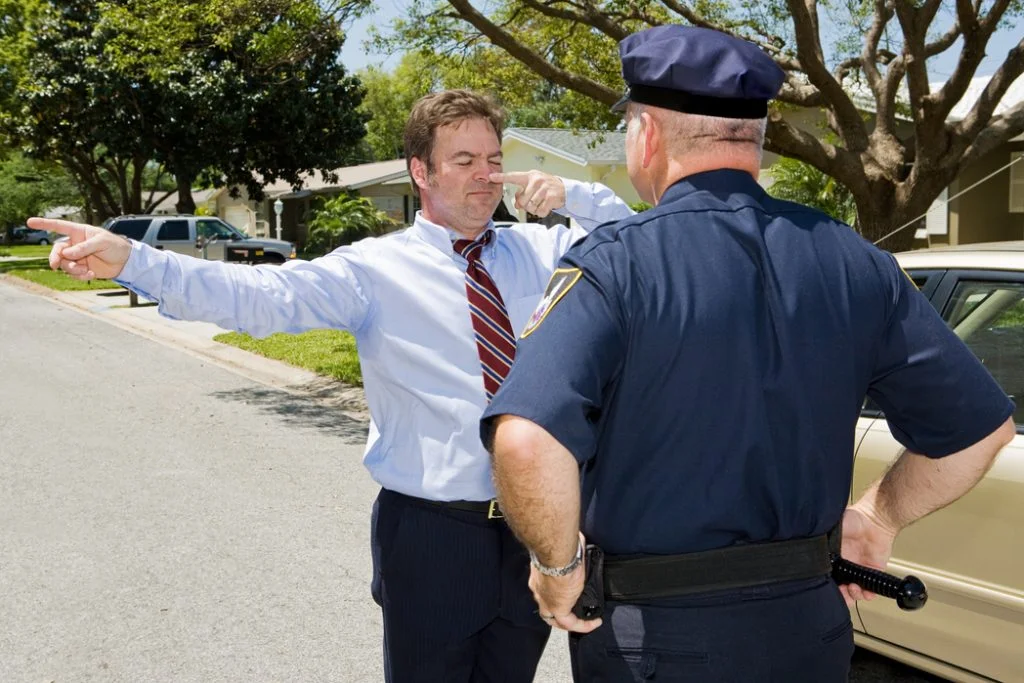
A question we often get is what evidence is necessary to prove a medical excuse for a roadside sobriety test refusal. If a police officer suspects a driver has a drug in their body, one of the tools they use to detect impairment is a roadside sobriety test, also known as a standard field sobriety test (SFST).
Section 320.27 of the Criminal Code sets out the roadside sobriety test. It consists of several tests of a person’s coordination intended to detect drug impairment. Suspected impaired drivers may be asked to walk in a straight line and turn, walk heel-to-toe, stand on one leg or follow a pen with their eyes.
What is a medical excuse for roadside sobriety test refusal?
Because these are physical tests, people may have a valid medical reason why they cannot perform them. However, it is up to the defendant to prove their medical excuse is more likely than not a valid reason for refusing or failing to comply with a roadside sobriety test demand.
Refusal is a serious offence, with punishments on a par with an actual conviction for drug-impaired driving. As of December last year, all sobriety test demands are mandatory and if convicted, you could get a fine of up to $2,000 and a one-year driving prohibition.
R. v. Le Clair
A recent case provides a good example of what evidence is necessary to prove a medical excuse for not participating in a roadside sobriety test. Mr. Le Clair was charged with failing or refusing to comply with a police officer’s roadside sobriety test demand.
Mr. Le Clair gave three defences to the charge in Court: that the police officer did not have sufficient grounds to make the demand; that the mens rea element – the intention or knowledge of committing the offence – had not been met; and that he had a reasonable medical excuse for not performing the tests.
The insufficient grounds defence was dismissed by the provincial court judge who found the officer’s evidence met the “reasonable grounds to suspect” standard. The constable testified that her suspicion was based on information received from the Starbucks manager; her observation that Mr. Le Clair’s truck was parked in an awkward way; her observation of Mr. Le Clair slumped at the wheel; and her observation of his hand trembling.
She could not smell liquor and when she asked if he had any medical condition that might explain his physical condition, he said no. The judge, therefore, found the officer had reasonable grounds to suspect had a drug in his body.
During one of the coordination tests, Mr. Le Clair said he would not be continuing with the test. The judge said this amounted to “clear and unequivocal” evidence of a fixed state of mind, and the mens rea element of the offence was thereby met.
But it was the defendant’s last defence, that he had reasonable medical grounds to refuse the roadside sobriety test, that is our main concern here.
Reasonable test for medical excuses
As mentioned before, the accused has the burden of proving on the balance of probabilities that they have a reasonable excuse for not participating in a roadside sobriety test. The defendant must, therefore, put forward evidence to prove why their condition prevented them from participating in the test.
In Mr. Le Clair’s case, he testified that he had broken his right ankle two years prior after falling from a ladder and he suffered soft tissue damage to his neck, shoulder and lower back from an earlier vehicle collision.
Simply having a medical condition, however, does not constitute a defence for refusing a roadside sobriety test. In order for a medical condition to provide reasonable grounds, it must make the test “either extremely difficult or extremely painful or uncomfortable or involve some risk to the accused’s health”.
The police officer testified that Mr. Le Clair gave no indication he was having physical difficulty or discomfort when he performed a test to walk heel-to-toe. The judge also noted that if the defendant had used his injured right ankle as an excuse not to perform a stand-on-one-foot test, this would not have been valid as he could have simply used his other foot.
Medical evidence
A person charged with refusing to comply with a roadside sobriety test demand can submit medical evidence to support their excuse. In Mr. Le Clair’s case, he did not provide any such evidence and the judge noted, “I would have thought that in a situation where he had broken his ankle only months before his dealings with the police, it would not be difficult to obtain medical evidence if it were supportive.”
Because the burden of proof is on the accused in these cases, failing to provide medical evidence of an excuse for a roadside sobriety test refusal may count against them. It is, therefore, a good idea to have medical evidence or, at the very least, provide a reason for its absence.
What to do if you have a medical excuse for a roadside sobriety test refusal
To summarize, if you have a medical excuse for a roadside sobriety test refusal charge, you must convince the Court that it specifically prevented you from participating. Furthermore, you must prove how doing so would have been extremely difficult, painful or could have caused further injury. It is also a good idea to provide medical evidence of your injury.
Tests such as these are what police use to if they suspect you have been driving while impaired by drugs. If they suspect you of cannabis-impaired driving, for example, you may be required to perform an SFST. Following the legalization of cannabis, it is important to know the standard of proof if you have a medical condition and you are compelled to do a roadside sobriety test.
If you have been charged with failing to comply with a roadside sobriety test and you think you have a valid medical excuse, we can help. Call us on 604-685-8889.
What about medical reasons for roadside breathalyzer? Why are medical conditions allowed for sobriety check, but apparently not for breathalyzer? Worth an update article.
I agree.. i was served with irp for refusal after 9 attempts on a breatakizer in 12 minuites .. I have asthma and a lung infection at the time and could not physically get enough breath.