
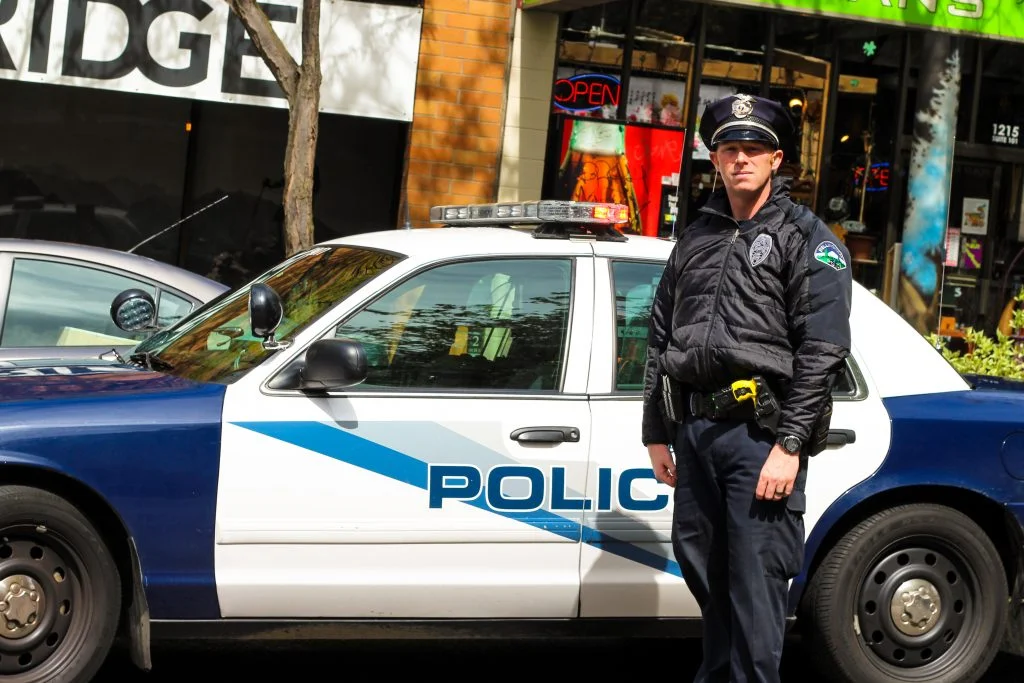
A police officer has just stopped you for suspected marijuana–impaired driving. Perhaps the officer was tipped off by how you’re driving, or you had the windows rolled down and they smelled a whiff of pot. Either way, you’re now pulled over. What is likely to happen is the officer is going to then question you.
They’ll ask how much marijuana you had consumed. How recently? Whether you have marijuana on you in the vehicle or on your person. As with most circumstances, we would advise you to use your right to remain silent, apart from providing your licence and insurance, stating your name and address if asked, and the name and address of the registered owner.
The officer has two options. To investigate you for drug-impaired driving as part of a Criminal Code investigation, or to investigate you for drug-affected driving, as part of a Motor Vehicle Act investigation. In BC, it’s likely that an officer will choose the latter. The reason is simple. It’s easier to hold up in court.
The maximum penalty on even a first offence is five years imprisonment.
The Criminal Code violation, of course, comes with a harsher penalty. Under s. 253(1), which stipulates it is illegal to operate a vehicle while impaired by a drug or alcohol, the maximum penalty on even a first offence is five years imprisonment.
The administrative penalty in BC, set under s. 215(3) of the Motor Vehicle Act, allows a 24-hour prohibition and impoundment instead, and also allows for your licence to be taken away for longer periods of time based on your driving record.
How police investigate for marijuana impaired driving
In either case, the investigation is likely to begin like this. An officer who is trained to conduct a Standardized Field Sobriety Test will ask you to perform a series of three tests. You can learn more about the SFST tests here, but essentially, they involve standing on one foot for 30 seconds, walking in a line and turning, and following an object with your eyes.
In a typical Motor Vehicle Act marijuana-affected driving investigation in British Columbia, officers must prove that the driver either “demonstrated clear evidence of erratic driving,” or “exhibited an impaired physical ability.”
The SFST test, based on a trained officer’s opinion, is usually sufficient to uphold an officer’s decision to issue a 24-hour driving prohibition. The law also does not provide an opportunity to review, or dispute, the officer’s opinion outside of filing for a judicial review at the BC Supreme Court.
It is imperative to seek the counsel of a lawyer experienced in impaired driving law.
If you choose to challenge the 24-hour driving prohibition for marijuana-affected driving in court, it is imperative to seek the counsel of a lawyer experienced in impaired driving law.
A criminal drug-impaired driving charge is tougher to uphold
Remember that in BC’s Motor Vehicle Act legislation, the law sets the bar for prohibition at drug “affected” driving, not “impaired.” There are a few tests, but essentially nobody, not the police nor the courts, are really able to determine how much marijuana it takes to make someone “impaired,” nor is there a proper way to measure this impairment.
This is where the Drug Recognition Experts come in. These are officers that are trained to do tests that are similar to, but also more thorough than the previous Standardized Field Sobriety Tests. There are 12 steps performed by these DRE officers in total, and you can check out the steps here.
But even when the Drug Recognition Expert is convinced that you have consumed marijuana, and that your ability to drive was impaired by the consumption, this is often insufficient for a criminal impaired charge.
It’s because the tests themselves are inherently faulty. Courts have consistently recognized that even sober members of the public cannot perform some of the tests. Here’s what one judge in the Ontario Court of Justice said:
“Even with some of the physical motor tests it’s not plain how the results relate to impairment at the time of driving. There was no evidence about the relationship, if any, between performance on the one-legged-stand test and the ability to drive. With no baseline as to how the average sober person performs and no baseline as to how this particular accused with his injuries performs sober as opposed to when he’s in an impaired state, it’s not plain what to make of the results.”
So often, police will also request a urine sample. If there has been consumption, these tests are likely to come back positive for marijuana. But still, it means nothing as far as impairment goes. Simply, the test can only confirm whether the drug is present, and not what impact this drug has on a driver’s sobriety.
It’s even recognized that THC can remain in urine for up to 30 days after consumption.
What does this mean for marijuana–impaired driving in BC?
The provincial government has already announced a new 90-day administrative driving prohibition system for marijuana.
We think it may be like the current immediate roadside prohibition system for alcohol-impaired drivers, in that there will be varying levels of penalties depending on how much marijuana someone has in their system.
Police forces across the country are also training more Drug Recognition Expert officers. Additionally, law enforcement has been practising with drug-swab roadside screening devices. But like the other tools police rely on to examine for marijuana–impairment, these drug swabs cannot determine the amount of marijuana someone has in their system.
At this point, it seems that while government is rolling out punishments, per se limits of 2 to 5 nanograms of THC per millilitre of blood, it’s looking extremely difficult to catch people actually in the act.
For now, BC is at least equipped with 24-hour prohibitions for drugs at a much lower standard of proof. This is an offence we continue to see officers issuing notices for, and something we continue to challenge in the courts through judicial reviews.
But as far as what will occur when legalization is finally here? We’re not sure. We don’t think the police are, either. The courts have already demonstrated that most of the tools used by law enforcement to determine marijuana impairment are simply insufficient.
Perhaps one day, it’ll come down to mandatory blood tests? Time will tell.
See more:
BC’s new pot laws means bad news for ‘N’ drivers
Drug Recognition Experts can allege you’re driving high when sober
Legal marijuana regulations announced in British Columbia
High standards for proving drug impaired driving prohibitions
24-hour driving prohibitions for alcohol vs. 24-hour driving prohibitions for drugs