
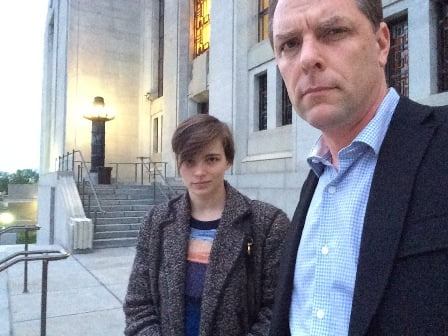
We’ve arrived in Ottawa. We’ve got all of our material and argument together. We’re prepared for a big day in IRP history.
And it will be a big day. Last Friday we received a fax from the registry at the Supreme Court of Canada listing the order of cases and speakers. The Wilson case will be first which means that Kyla is the first one to speak at the Supreme Court of Canada about IRPs. She is allotted 30 minutes. Counsel for the BC Government will speak next and Kyla will be permitted a 5-minute reply. Then the Wilson case will be complete and the Court will move on to the Goodwin matter (formerly Sivia).
The decision of the Court will likely have major implications for the future of the current versions of the IRP law.
Implications of the big day in IRP history
Our role is the Wilson matter, which won’t upset the entire IRP scheme but, if our argument is accepted, it may ensure fewer innocent people get IRPs.
As far as the challenges to the constitutional validity of the IRP scheme are concerned, we’re late to the party and by the time we arrived in a sense the party is long over because the law has been substantially changed twice since the Goodwin decision was handed down.
Still, even though the first version of the IRP law is gone, the decision of the Court will likely have major implications for the future of the current versions of the IRP law and any prospective similar law that might be in the pipeline in other provinces.
Sad to us is that many of the important arguments about the IRP scheme have been lost in the shuffle. Things we’ve learned since the original Sivia decision was argued are not going to be issues before the Court. Other concerns about the scheme might not be revealed for years. Concerns with the revised versions of the IRP scheme are likely never to make it to the Supreme Court of Canada.
This is unfortunate.
Unexpected implications
One unexpected implication of the IRP scheme was that more people challenge their IRPs and are willing to take them to court than the Government ever expected.
As we’ve said before, this is a revolutionary change to the law and revolutions rarely go as planned, and usually they fail in the long run.
Another thing that seems to be going the wrong way with the IRP scheme is that IRPs appear to be increasing the numbers of drinking drivers.
We’ve noticed that people are less ashamed to speak to their friends and family about an IRP. Back in the day when the standard course of a DUI investigation was an arrest and criminal charges, the person charged was so ashamed about the pending impaired driving case in court that they kept it a tight secret. Before the IRP scheme came into play, a drunk-driving charge in BC was a serious moral failing and something about which people were ashamed.
With an IRP you never need to face a judge or stand there in open court. Although the punishment is very similar, the process is different and as a result the stigma is different, particularly so because now most people know other people who have received an IRP. In fact, so many people have been issued IRPs that drinking and driving has become normal.
Deaths may be down, (we don’t accept any connection to the IRP scheme) but from what we can see drinking and driving is up in BC because the behaviour has become normalized by virtue of the huge number of IRPs that have been issued.
Our predictions
We’ve made a lot of correct predictions about how the IRP scheme would play out, but this one we missed. Nevertheless, this is what we’re seeing on the ground. Unlike criminal DUI charges, people who receive IRPs tell their friends and families about it. We receive referrals from clients who tell us that their friends, John, Joe, Colleen and Bob were defended by our office when they got an IRP.
This was never how things worked with criminal impaired driving cases. People didn’t talk about it with their friends. A criminal impaired driving charge was something you wanted to keep private.
We see that driving after drinking has become viewed as normal behaviour by virtue of the IRP scheme. How’s that for an ironic twist? Perhaps in 10 years someone will study this and produce a report to support our conclusions.
In any event, this strange twist will never be a consideration before the Supreme Court of Canada when thinking about the IRP scheme.
We ask for little
Tuesday will be a big day in IRP history because it may be the only time a version of the IRP law is considered by the Supreme Court of Canada.
For us the Wilson case is an opportunity to ensure that checks and balances written into the legislation are applied by the RoadSafetyBC tribunal. We’ve come to the view that the only way to ensure that the BC Government doesn’t run roughshod over drivers is to appeal OSMV decisions.
The IRP law prompts the police to have an opinion. We’re just asking that they do their job. If they do their job, fewer innocent people will be issued IRPs.