
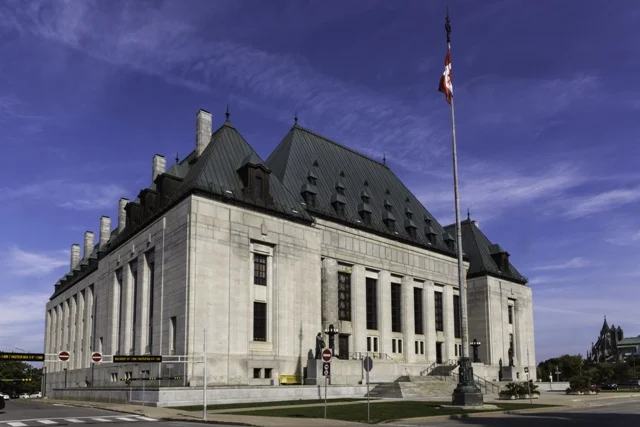
In one week the Wilson case and the Goodwin (Sivia) case will be argued at the Supreme Court of Canada. It’s hard to believe what a long road this has been, but here we are. We’re at the Supreme Court of Canada next week.
For us it’s a no-brainer because some officers have told us that there were occasions when they felt they didn’t have the right opinion despite the test results.
Our role is exclusive to the Wilson case. When Kyla looked at the BC Court of Appeal decision in Wilson she felt that the Court failed to apply the correct test to sort out the ambiguity that appears on the face of the IRP legislation. She figured that the BC Court of Appeal was viewing the law as a means-to-an end without giving the proper context to the legislation bearing in mind that the law completely eliminates the Charter of Rights by simply shunting harsh punishment to a Government tribunal. She figures that if there is an ambiguity it should be read in a manner that brings the law closer to being Charter compliant.
It’s a smart argument and it speaks to the threat of allowing governments to strip away Charter Rights in the manner we’ve seen with the IRP scheme and soon traffic tickets. If Charter Rights actually matter, here is where the rubber meets the road.
The actual matter at the Supreme Court of Canada
Lost in the consideration to some extent is the actual wording of the Motor Vehicle Act. The crucial portions say this:
215.41…
(b) the peace officer has reasonable grounds to believe, as a result of the analysis, that the driver’s ability to drive is affected by alcohol,
This is what we’re actually arguing about. If the police officer does NOT have reasonable grounds to believe that the driver’s ability to drive is affected by alcohol, should he or she be entitled to NOT issue a driving prohibition?
So, for example, the officer is looking at the driver and the driver exhibits no symptoms of alcohol consumption, not even an odour of liquor but admitted to drinking a half glass of wine finishing the drink 16 minutes before blowing…
In this circumstance, should the police officer be permitted to conclude that they don’t have reasonable grounds to conclude that the driver’s ability to drive is affected by alcohol? If the police officer issues an IRP in such a case, should it not be reviewable on the basis of the officer not having reasonable and probable grounds?
This is not a far-out scenario. It will happen somewhere in BC tonight.
What about when the officer knows that the Approved Screening Device was dropped earlier by another officer? Is it not fair and appropriate to take those words at face value and say that despite the analysis the officer may not have reasonable grounds to believe?
If it’s not reasonable and it’s not probable, shouldn’t the tribunal want to revoke the prohibition?
For us it’s a no-brainer because some officers have told us that there were occasions when they felt they didn’t have the right opinion despite the test results. Our view isn’t at issue, however.
What the hell were they thinking?
We think, when it comes right down to it, either the legislative assembly intended to give the police a check-valve role or they intended to give them a check-valve role but that the law was written deliberately ambiguously so as to suggest that they were giving the police a check-valve role when none was intended. Either way, it’s not superfluous verbiage. “Reasonable grounds” are important words.
Why does any of it matter?
The IRP scheme stinks from head to toe. It exists because the BC Government wanted to take away Charter Rights and turn alleged drunk drivers into a source of money. It’s the type of behaviour you would expect in a tyranny. From our read of things the only reason the BC Government got away with it so far was because alleged drunk drivers are the pariahs of our age.
As far as we’re concerned, the court decisions that facilitate the IRP scheme are bad law in that the precedent value will be used to take away rights in many other areas of the law. The BC Government successfully exploited alleged drunk drivers to undermine the Charter of Rights.
As far as we’re concerned, we need to ensure that Charter values are injected into any so-called “Administrative” scheme that is written as a defacto replacement of the criminal law, such as we see with IRPs.
That’s why we’re at the Supreme Court of Canada next week. Simply put, we believe in the Charter of Rights.
Getting to the Supreme Court of Canada
On first glance you may not recognize the national importance of the Wilson case. This is all about the tribunilization movement that we speak about often here. We know that governments are impatiently waiting to take away your Charter Rights.
Treating the populace with a modicum of respect and complying with Charter Rights costs a lot of money. Most governments these days view the justice system with “rights” as a costly impediment to their goals. They would like to turn the justice system into a revenue generating system.
For reasons known to the Supreme Court of Canada, they viewed this as a case of national importance. We agree (for reasons known to us). Consequently they accepted Kyla’s leave to appeal application and granted us this hearing.
What about the work?
In our office this has been largely Kyla’s solo effort. She wrote the leave to appeal and the factum which we encourage you to read. She’s put hundreds of unpaid hours into this. If there’s one thing you can say about the lawyers in our office, we’re dedicated.
We’re so dedicated that we’re paying the bill for this. We were successful at the first IRP case to the Supreme Court of Canada so a portion of our expenses were paid by the Government. We paid for the rest.
As for the Wilson case, if we lose we ourselves face the prospect of paying the costs for the Government to have defended our appeal. And of course, we’ve paid many thousands of dollars just to get to the Supreme Court of Canada and to travel to Ottawa. So we’re dedicated and we’re optimistic.
And thanks go to…
Kyla Lee: It requires a certain mix of creativity, fortitude and zealotry to be the type of lawyer who spends weekends and evenings advancing a cause without any financial benefit and at great financial risk. Kyla has that level of understanding that we require of the lawyers in our office to be able to take the big objective view of a challenge like this. As an office we’re putting our money and time behind this. Kyla herself has invested and risked her own money and time into this.
Supreme Advocacy: When you go to the Supreme Court of Canada you need to retain lawyers on site to guide you through, make sure all of the steps are followed, format and fix your documents and file everything that needs to be filed. A number of Ottawa firms offer this service.
The reason we hired Supreme Advocacy is because they were closely monitoring the legal challenges to the IRP scheme from the start. We became aware that they were already framing our arguments and thinking about how we should approach this. When we contacted them, they were ready to run with it and they’ve been extremely helpful. Moreover, like us they provide real value for the money.
We’re really good at what we do and we recognized right away that they’re really good at what they do. We have great admiration and we’re very thankful for the lawyers and staff of Supreme Advocacy.
Staff and Lawyers at Acumen Law: These issues percolate through our office and everyone has something to contribute. Tavneet, Ting Ting and Debbie – legal assistants who are thoughtful, worldly and well educated, have been essential in helping us frame arguments and forward our causes. They understand how the OSMV tribunal functions and they have particular insight which helps us every day.
As well, all of the lawyers of our office have had their say and input into these projects that we advance. We discuss issues concerning IRPs all day long almost every day.
Dan is another welcome addition to the A-Team.
People who follow our blog: We know you’re reading our blog and we feel dedication to you. Moreover, we appreciate all of the kind comments and thoughtful observations on our Facebook page and that we’ve received in email. We’re doing our best. We’re motivated to keep going because we know you’re behind us.
Lawyers who have mentored us: We can’t tell you the names, but lawyers from around BC and particularly lawyers who appear often at the Supreme Court of Canada have contacted us to offer their extremely valuable time and ideas. We report with humility that the legal community is working in the best interests of the law, as it should be in our view. Kudos to lawyers.
Good arguments and luck
Kyla ran this from the start and she’s going to make the case at the Supreme Court of Canada. She has good arguments. She appreciates your good wishes.
You may note…
Mother’s Against Drunk Driving was refused intervener status to speak at the Wilson SCC appeal. Kyla wrote to oppose their application for intervener status. She was successful.